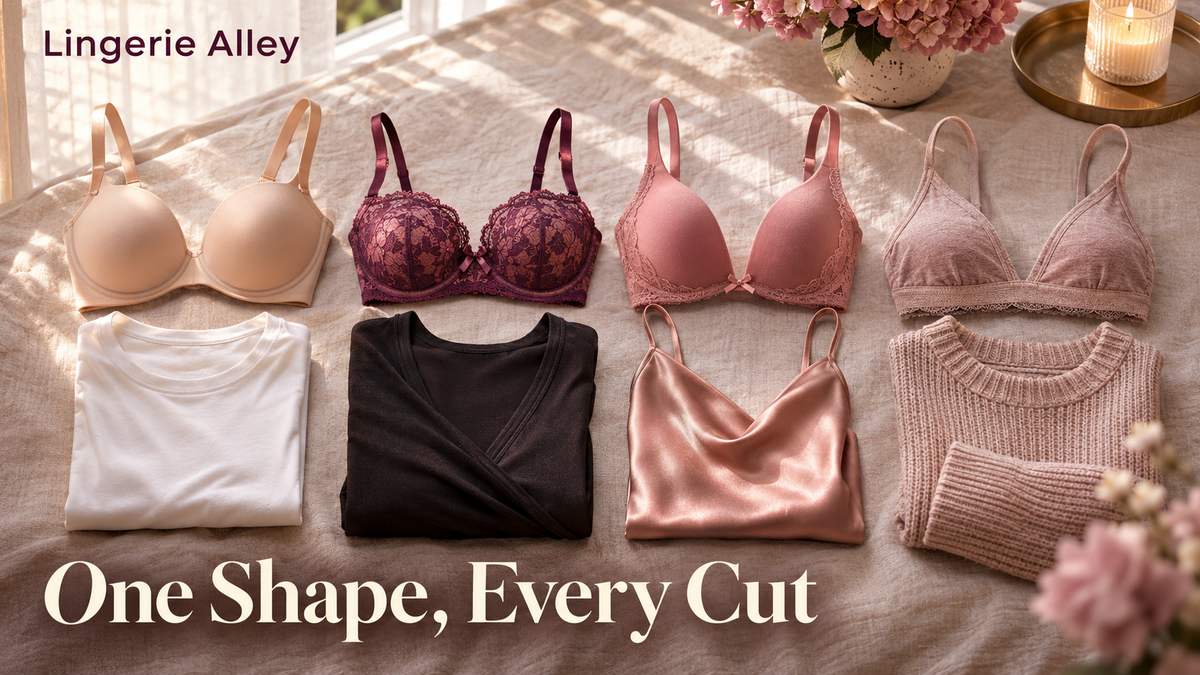
Put on a plain white T-shirt, turn sideways to a mirror and look at the line from your collarbone to the bust point. If it slopes gently and then rounds out underneath, with a little more fullness below the nipple than above it, you are probably looking at a teardrop shape. Fitters often call it the most common shape they see, and it is also one of the easiest to dress. The upper part of the breast is not empty, the lower part is not heavy enough to need special engineering, and the roots are usually average width.
That changes the question. Plenty of shapes need a specific cut to stop gaping or spilling. Teardrop breasts sit happily in most of them, so the useful question is which cut suits what you are wearing over it. This guide goes outfit by outfit, then covers the fitting checks that matter for this shape.
What a Teardrop Shape Means for Bra Fit
A teardrop breast is round at the bottom and slopes more gently at the top. Picture a round breast with a little of its upper fullness moved below the nipple: not evenly full like a round shape, and not narrow on top with a weighty base like a bell. If the description of bell-shaped breasts sounds closer, with clear heaviness and a noticeably slim upper chest, read our guide to bras for bell-shaped breasts instead, because the support needs are different.
For a teardrop shape, three fit facts follow from that slope:
- The lower cup does the work. Most of the volume sits there, so the lower cup needs enough depth and a wire that sits fully behind the tissue at the fold.
- The upper cup has to meet a gentle slope. A rigid, very tall cup can leave a small hollow at the top. A cup with a stretch lace edge, or a slightly lower neckline, closes it.
- Lift is optional, not required. You can choose a cut that pushes tissue up for a rounder top, or one that keeps your natural slope. Neither is more correct.
If you are not sure which shape you have, the style quiz includes a breast shape step with 12 types and will steer the product results toward cuts that fit it.
The Best Bra Cut for Each Outfit
Fitted T-shirts and thin knits: a molded T-shirt bra
Under a ribbed tee or a fine-gauge sweater, a seamless molded cup gives the smoothest line. For a teardrop shape, the detail to check is the top edge. Look for a cup that is slightly lower cut or that finishes in a thin, flexible edge, so it lies flat against the gentle upper slope instead of standing away from it. A spacer foam cup (the breathable, slightly springy kind) holds its shape without adding much bulk.
Test it with the shirt on. Run a finger along the top of the cup through the fabric. If you feel a ridge, the cup is too tall or the size is off. If you feel a smooth transition, it is working.
Wrap dresses and V-necks: a plunge
A plunge has a low center gore, often with angled cups that bring the breasts slightly toward the middle. Teardrop breasts tend to fill a plunge well because the fuller lower half anchors in the cup while the slope above sits under the angled edge. Under a deep wrap dress, choose a plunge with a gore low enough that it stays hidden at the deepest point of the V.
The gore should tack, meaning it lies flat against your sternum. If it floats away from your chest, try a cup size up or a style with a narrower gore before giving up on plunges.
Square necks, scoop necks and sweetheart tops: a balconette
A balconette has a wider, more horizontal top edge and straps set further out. It lifts from below and shows a rounder top line, which is the look many people want with a square neckline or a sweetheart top. On a teardrop shape, a balconette gently pushes the lower fullness upward, so the top of the breast looks fuller than it does in a plunge.
The tradeoff is width. Balconette straps sit wide, so if your shoulders slope, check that the straps stay put when you raise your arms. For the full head-to-head, our balconette vs plunge comparison breaks down which neckline goes with which cut.
Sheer blouses and lace tops: an unlined seamed bra
When the bra is meant to show a little, an unlined bra with a vertical or diagonal cup seam looks deliberate and pretty. Seamed cups are built from two or three panels, which lets the cup follow your real shape instead of imposing one. On a teardrop shape, a three-part cup with a side support panel gives a soft, natural point without padding.
A sheer tulle or fine mesh cup reads as delicate. A heavier stretch lace reads as more structured. Both work here, since the shape does not need the cup to hide anything.
Lounging, travel and long desk days: a wireless or soft-cup bra
Teardrop breasts are often comfortable in wireless styles because the lower-pole fullness has a natural resting place in a soft cup. Look for a wireless bra with a wide underband (at least an inch of elastic) and a sewn-in sling or seam under the cup. Those two features stop the cup from riding up and keep the shape even without a wire.
A pure stretch bralette with no seams gives a flatter, more compressed look. That suits a loose sweater fine, but if you want shape under a closer knit, choose a soft-cup bra with seams.
Workouts: match the impact level
Sports bras are built around movement rather than shape, so pick by activity first. For yoga or walking, a light compression crop is fine. For running or jumping, an encapsulation style with separate cups usually controls movement better and keeps the rounded lower shape instead of pressing it flat.
Fitting Tests That Matter for This Shape
The usual fit basics apply: a band that sits level and firm, wires that sit on the ribcage rather than on tissue, and straps doing a small share of the support. A few checks are especially relevant for teardrop breasts.
The lean-forward test
Bend forward from the hips so the breasts fall into the cups, fasten the band on the loosest hook, then stand and settle the tissue in each cup with the opposite hand. Teardrop tissue tends to rest low, so this step makes sure the lower cup is fully filled before you judge the fit.
The top-edge check
Look at the top of each cup in the mirror. A small gap is the most common issue for this shape, and it usually means the cup is too tall in the upper half, not that you need a smaller size. Before you size down, try a lower-cut style in the same size. Sizing down to close a top gap often makes the wire sit on breast tissue at the side.
The wire-at-the-fold check
Press gently on the wire where it meets the fold under the breast, then follow it up toward your underarm. It should rest on ribcage all the way around. If the wire sits on soft tissue at the bottom or the side, the cup is usually too small, or the band is loose enough to let the whole bra ride up. Fix the band first, then go up a cup. This matters more for a teardrop shape than it looks, because the fold is where most of your volume sits.
Building a Small Bra Wardrobe
You do not need a drawer full of bras for this shape. Three or four cover most outfits:
- a molded T-shirt bra in a shade close to your skin tone, for light tops
- a plunge, for V-necks and wrap dresses
- a balconette or seamed unlined bra, for square necks and for when the bra is part of the look
- a wireless soft-cup bra, for home days and travel
If you rotate them and wash by hand or on a delicate cycle in a mesh bag, the band elastic lasts much longer. When the band starts riding up on the loosest hook, it has stretched out, and that bra is due for replacement.
When you shop for the next one, bring the top you most often struggle to dress and try bras on under it in the fitting room. Five minutes with the actual neckline will tell you more about the right cut than any size chart.
Frequently Asked Questions
Is teardrop the most common breast shape?
Fitters and shape guides commonly describe teardrop as one of the most frequent shapes, but there is no single authoritative count. Shape also changes over time with weight, hormones, pregnancy and age. Treat the label as a fitting shortcut, not a fixed category.
Do teardrop breasts need padded bras?
No. Padding is a style choice for this shape, not a fit requirement. A thin molded cup smooths the line under knits, while unlined seamed cups follow your natural shape closely. Choose by what you plan to wear over it.
Why does my bra gape at the top even though it fits everywhere else?
The cup is likely taller in the upper half than your gentle slope fills. Try a lower-cut style, a balconette, or a cup with a stretch lace top edge in the same size. Going down a cup size often moves the wire onto breast tissue instead.
Can teardrop and bell shapes be confused?
Yes, because both have more fullness below the nipple. Bell-shaped breasts usually have a noticeably narrow upper chest and a heavier, wider base, and they tend to need firmer support features. Teardrop is a milder version, and most cuts work on it. If you sit between the two, start with a seamed cup and a firm band, which suit both.
Find Your Perfect Fit
Take our 60-second quiz and get personalized lingerie recommendations matched to your body, style, and budget.
Take the Quiz