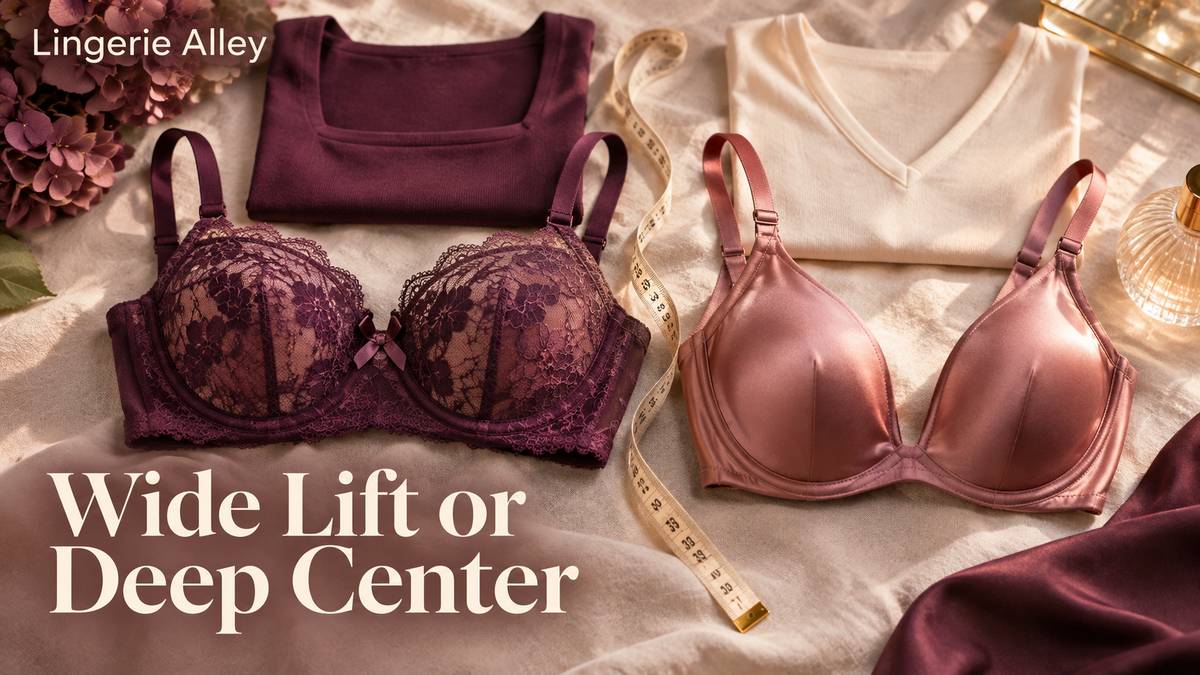
Lay a balconette and a plunge flat on a table, cups up, and look at the center of each. The balconette's gore, the panel between the cups, is usually a rectangle of moderate height, and the wires on either side rise fairly straight before curving outward. The plunge's gore is a narrow, low triangle, often barely taller than the band, and the wires lean in toward it at a steep angle. Everything else about how these two bras look and feel follows from that one difference at the center.
A balconette pushes tissue up and slightly out, toward the straps. A plunge gathers it in and forward, toward the middle. Neither is the better bra. They do opposite jobs, and the right one depends on where your breast tissue sits to begin with and what neckline you are putting over it.
How each bra is built
The balconette
The name comes from a balcony, and the cup shape explains it: a fairly horizontal top edge that sits across the upper chest like a ledge. Typical construction details:
- A medium-height gore, often around the same height as the wires at the center.
- Straps set wide, close to the outer edge of the cup, sometimes right at the corner.
- Cups usually built from two or three pieces, with a vertical seam that lifts from underneath, or a molded cup shaped the same way.
- Coverage that stops roughly halfway to three quarters up the breast.
The vertical seam is the working part. It shapes the cup so the lower half holds the tissue and pushes it upward, which is why a balconette gives a rounded, full upper chest. The wide straps keep that top edge level instead of letting it pull toward the neck.
Balconette and demi cup are often used as if they were the same thing, and brands label them inconsistently. If the labeling confusion is what brought you here, our explainer on what a demi cup bra is sorts out the terms.
The plunge
A plunge is defined by depth at the center. Typical construction details:
- A low gore, sometimes only an inch or so above the band.
- Wires that are shorter on the inner side and angled in toward the center.
- Straps set closer to the middle of each cup, often on a more vertical line.
- Cups that are cut on a diagonal, high at the outer edge and dropping steeply toward the gore.
The angled cut and low center bring the breasts closer together and project them forward, which creates a V of cleavage. Many plunges add padding at the outer lower cup to push tissue inward.
Deciding by breast shape
Shape matters here because each bra assumes something about your tissue. A balconette assumes there is enough tissue at the bottom of the breast for its lower cup to lift, and that the upper cup will be at least partly filled. A plunge assumes the tissue can travel toward the center, and that a narrow, low gore will find bare sternum.
The quiz-shape chart
These are the 12 shapes from our style quiz, with the cut that tends to do the most for each. "Tends to" is doing real work in that sentence: a well-fitted bra of the less-suited cut will beat a badly fitted one of the better cut every time.
| Quiz shape | Leans toward | Why |
|---|---|---|
| Archetypal | Either | Even fullness fills both cuts; pick by neckline. |
| Asymmetric | Balconette | Seamed cups adapt to two different volumes more easily than a molded plunge. |
| Athletic | Plunge | A wide, firm base with less projection often suits angled wires better than a tall, straight balconette cup. |
| Bell | Balconette | Lower fullness gives the seamed lower cup something to lift. |
| Close set | Plunge | The low, narrow gore has room to sit on bare sternum. |
| Conical | Balconette (seamed) | Vertical seams build depth for a projected shape; a molded plunge is often too shallow at the apex. |
| East-west | Plunge | Angled cups bring outward-pointing tissue toward the center. |
| Relaxed | Balconette | Lift from below and a wider strap set handle softer tissue. |
| Round | Either | Full top and bottom work in both; a plunge can overflow at the inner edge if the gore is very low. |
| Side set | Balconette | Wide, shallow wires usually start where wide-set tissue starts. A narrow plunge pulls the cups inward and can leave the inner cups empty. |
| Slender | Plunge | Less projection fills a shallow plunge cup without empty space at the top. |
| Teardrop | Balconette | Lower fullness and a lighter top suit a cup that lifts from underneath. |
For close-set breasts specifically, the gore is the whole story, and the close-set bra guide ranks styles by gore height and width. The short version: a plunge is usually the easiest underwire cut for that shape.
Two fitting tests that settle it
The chart is a starting point. These two tests in a fitting room, or at home with an order you can return, give you the real answer.
The gore test. Put the bra on, fasten it on the loosest hook, scoop your tissue into each cup, and press the center of the gore with one finger. It should already be lying against your breastbone, and pressing should not move it. If a balconette's gore stands away from your chest even though the cups are not too small, the gore is probably too tall for the space you have, and a plunge is worth trying. If a plunge's gore digs into tissue at the inner edge, the wires are angled into breast tissue rather than beside it.
The top-edge test. Stand side-on to a mirror and look at where the top of the cup meets your breast. On a balconette, you want a smooth line, no step where tissue spills over and no gap where the cup stands away. A gap at the top of a balconette usually means you have less upper fullness than the cup is built for. On a plunge, look at the inner top edge near the gore. Overflow there means the cup is cut too low at the center for your fullness, which is common on round shapes.
If one cut passes both tests and the other fails one, you have your answer for that brand.
Deciding by neckline
Once a bra fits, the outfit usually decides which one you reach for.
Necklines that call for a plunge
- Deep V and wrap tops. The plunge's V follows the neckline. A balconette's center would show above the V.
- Button-downs worn open two or three buttons. Same logic, a lower center keeps the bra out of view.
Necklines that call for a balconette
- Square necklines. The balconette's horizontal top edge sits parallel to the neckline, so neither the cup nor the gore peeks out.
- Sweetheart and wide scoop necklines. The wide strap set stays hidden under a wide neckline, where plunge straps closer to the center can show.
- Off-the-shoulder and wide boat necks. Look for a balconette with convertible or removable straps.
- Corset-style and structured bodices. The balconette shape echoes the line of the garment.
Necklines where either works
High crew necks, turtlenecks and most T-shirts hide both. Here, choose by what you want the silhouette to look like: a balconette gives rounder, higher fullness across the chest, a plunge gives a closer, more centered line.
Fabric and support differences you will feel
Balconettes put more of the lift on the lower cup and the straps. On larger cup sizes, the wide strap position can feel secure because it spreads the load toward the shoulder edge, but if your shoulders are narrow or sloped, wide-set straps are more likely to slip off. A balconette with a J-hook or straps that can be moved closer together helps.
Plunges concentrate the shaping on the angled cut and, often, padding. Because the gore is so low, a plunge leans more on the band for support. If the band is even slightly loose, the low center can tip forward. Check that the band sits level and snug before blaming the cups.
Both styles are made in a wide range of cup sizes, though in fuller cup sizes balconettes are often easier to find than plunges. If you wear a larger cup and like the plunge shape, look for plunges with seamed cups rather than heavily padded molded ones, since seamed cups tend to scale up with better support.
Frequently Asked Questions
Is a balconette or a plunge better for a large bust?
Either can work in a larger cup if the fit is right. Balconettes are often easier to find in fuller cup sizes and give lift from a seamed lower cup, while a plunge in a large cup should have a firm band and seamed rather than heavily padded cups. The gore test above is a better guide than cup size alone.
Does a plunge bra give more cleavage than a balconette?
A plunge creates a deeper, more centered V because the cups angle inward and the gore sits low. A balconette creates a rounder fullness higher on the chest, which reads as cleavage under a square or scoop neckline. Which looks like "more" depends on the neckline you wear over it.
Can I wear a balconette under a V-neck?
Under a shallow V, often yes. Under a deep V or a wrap top, the balconette's center gore usually sits higher than the bottom of the neckline and will show. A plunge, or a bra with a very low gore, is the safer choice for anything that drops below the sternum.
Why does my plunge bra gape at the top?
Gaping at the top of a plunge often means the cup is cut for more upper fullness than you have, or the cup is a size too large. Try the same band one cup size down, or a plunge with an unpadded lace upper cup that can stretch and fold to your shape.
One thing to try next
Take the two necklines you wear most often and try each bra under them, not just alone in the mirror. Then write down the brand, style name, size and cut of whichever bra passed both fitting tests, in your phone's notes. Wire shapes change between brands far more than sizes do, so the most useful thing you can carry into the next shopping trip is not your cup size, it is the name of the specific bra whose gore lay flat on you.
Find Your Perfect Fit
Take our 60-second quiz and get personalized lingerie recommendations matched to your body, style, and budget.
Take the Quiz