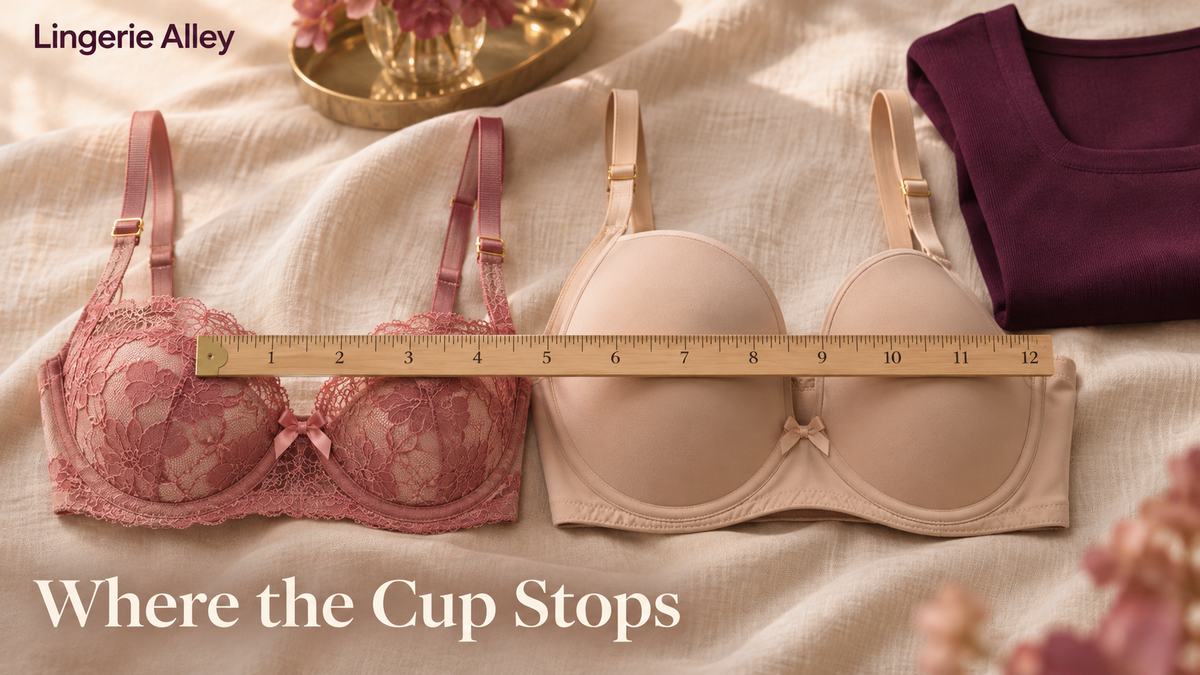
Lay a demi cup bra next to a full-coverage bra and line up the underwires. The wires match. The bands match. The difference is the top edge: on the full-coverage bra it climbs almost to the collarbone side of the breast, and on the demi it stops partway, cutting across the breast at about the level of the nipple or a little above it. That one line is the whole definition. Everything else about the style, from where the straps sit to which tops it pairs with, follows from where that edge falls.
What "Demi" Actually Means
Demi is French for half, and the name is a loose guide rather than a measurement. A demi cup covers somewhere between half and three-quarters of the breast. The lower part of the breast is held fully, the upper curve is left open, and the neckline of the bra runs fairly straight across or dips slightly toward the center.
There is no industry standard for exact height, and one brand's demi can sit an inch higher than another's. So when a product page says "demi," read it as "lower than full coverage, higher than a plunge's center," then check the photo.
A demi shows the top of the breast instead of covering it, keeps support coming from below through the wire, lower cup and band, and leaves room for wide necklines. It does not push the breasts together (a plunge's job) or add volume (that is padding, which a demi may or may not have).
How a Demi Cup Is Built
A few construction details predict how a demi will behave before you try it on.
The top edge
The top edge is usually finished with a narrow elastic or a stretch lace trim. Its job is to lie flat against the breast without pressing in. On a well-cut demi, that edge is cut on a slight curve that follows the breast, so it lies smoothly from wire to strap. On a cheaper one it can be a straight line that either digs in or stands away from the skin.
Cup seams
Demi cups come in three common builds:
- Molded (seamless). A single heat-formed foam cup. Smooth under fabric and holds its shape on its own. The fixed shape means it only fits breasts close to that shape.
- Two-part, horizontal seam. One seam runs across the cup. This gives a rounded lift and is common in lace demis.
- Three-part or vertical seams. One or more seams run upward from the wire. These give more lift and a more shaped, projected silhouette, and they are typical of what many brands call balconettes.
Seamed cups adjust to more breast shapes than molded ones, because the fabric settles around the tissue instead of asking the tissue to fill a fixed dome.
Wires and gore
Most demis are underwired. The gore (the center panel between the cups) tends to sit lower than a full-coverage bra's but higher than a plunge's, which is part of why a demi works under fairly open necklines.
Straps
Demi straps generally attach a little farther out on the cup than full-coverage straps do. Because the cup is shorter, the strap has less fabric to anchor into, so the angle matters more. If the strap pulls the cup edge outward when you move, the attachment point is wrong for your frame, not the cup size.
Demi vs Balconette: Why the Labels Overlap
This is where shopping gets confusing. Some brands treat demi and balconette as the same thing. Others treat demi as a coverage level and balconette as a specific style within it. A few use "balconette" only for very wide-set straps and a straight horizontal neckline, and call anything with closer-set straps a demi.
A rough working distinction that holds across most labels:
- Demi describes how much of the breast is covered. It can have straps set centrally or wide, and seams of any kind.
- Balconette describes a shape: a horizontal top edge like a balcony rail, straps set wide at the outer corners, and lift coming from vertical or three-part seams.
So most balconettes are demi height, but not every demi is a balconette. Since names will not settle it, judge the bra by three things you can see in the product photo:
- Where the straps meet the cup. At the outer corner points to balconette. Nearer the middle of the cup points to a classic demi.
- The shape of the top edge. Flat and horizontal, or gently scooped.
- The seams. Vertical seams usually mean balconette-style lift.
If you are also weighing a plunge, the balconette vs plunge bra comparison sets the two side by side by shape and neckline.
Who a Demi Cup Tends to Work For
A demi cup suits breasts whose fullness sits mostly in the lower half, because that is the part the cup holds. Round and teardrop shapes usually do well, and the open top shows off an even curve; the guide to the best bra for round breasts matches demis to outfits for that shape. Shallow breasts with less upper tissue can also find that a demi solves the empty-top-cup gap, simply because there is less cup above the tissue to stand away.
It takes more care in two cases:
- Fullness concentrated high on the breast. Tissue above the cup edge has nowhere to go, so it can spill over the top edge. A taller cup or a stretch-lace top edge often helps.
- Softer tissue that wants to move. A low edge holds less of the breast when you bend or move. A demi with seamed cups and a firm band can still work; a lightly lined lace demi may not feel secure.
None of this is a rule. It is a starting point, and the fitting tests below settle it. If you are not sure which shape you have, the breast-shape step of the style quiz walks through twelve shapes with drawings.
Fitting Tests to Run Before You Buy
Put the bra on with the band on the loosest hook, then scoop each breast into the cup with the opposite hand so all the tissue is inside the wire. Then run these checks.
The edge test
Run a finger along the top edge of each cup. It should lie flat with no gap and no line pressed into the skin. A gap of more than a finger's width usually means the cup is too tall or the wrong shape for you. A line of tissue rising over the edge usually means the cup is too small or cut too low for where your fullness sits.
The lean test
Bend forward from the hips, as if picking something up. This is where a low edge most often gives way. If breast tissue slides up and out over the edge, the cup is too shallow for you, even if it looked fine standing up.
The arm test
Raise both arms overhead, then lower them. The wire should stay put. If the band rides up and drags the cups with it, the band is too loose, which matters more in a demi because there is less cup to compensate.
The fabric test
Pull a thin, fitted knit top over the bra. A sharp ridge means the edge is digging in; a step where cup meets skin often means the cup is a touch big.
Square and Scoop Necklines: What a Demi Was Made For
The demi's real strength is necklines. Because the cup edge sits lower and runs roughly across, it disappears under shapes that would show a full-coverage bra.
- Square necklines. A horizontal neckline and a horizontal cup edge run parallel, so the bra stays hidden as long as the cup sits below the fabric. Look for a straight top edge and straps set slightly wide.
- Scoop necklines. A gentle scoop sits lower in the center than at the sides. A demi with a slightly scooped top edge follows that curve. Check the center: if the gore is tall, it can peek out at the bottom of the scoop.
- Sweetheart and wide boat necks. These open the chest across rather than down, which is where a demi helps most. For tops that slide off one or both shoulders, strap placement becomes the issue, covered in the guide to the bra for an off-the-shoulder top.
- Deep V-necks. Here a demi is usually the wrong tool. The center of a demi sits too high for a V that drops well below the bust line, and a plunge with a low gore is the better match.
Frequently Asked Questions
Is a demi cup bra supportive enough for larger cup sizes?
It can be, as long as the support comes from a firm band, a well-fitting wire and a seamed cup. Many brands make demis in fuller cup sizes, often with three-part or side-support panels. What changes with a bigger cup is how much the cut height matters, so run the lean test carefully.
Will a demi cup show under a T-shirt?
A molded demi with a smooth edge is usually invisible under a regular T-shirt. Lace demis can show texture under thin, tight knits. If the top edge leaves a ridge, try a demi with a bonded or laser-cut edge instead of an elastic trim.
Is a demi cup the same as a half cup?
They are close, and some brands use the names interchangeably. When a distinction is made, a half cup is usually cut lower, nearer to the nipple line, while a demi can reach up to about three-quarters coverage. Check the product photo rather than the name.
Can I wear a demi cup bra every day?
Yes, many people do. A demi is an everyday cut as much as an occasion one, especially in a seamless or lightly lined version. If you find yourself adjusting it during the day, that is usually a sign of fit, and the edge and lean tests will tell you which way to go.
Next time you shop, bring the top you want to wear the bra under, or wear it to the fitting room. Put the demi on, pull the top over it and look in a side mirror as well as straight on. The neckline is the reason to choose a demi in the first place, so test it against the actual neckline, not an imagined one.
Find Your Perfect Fit
Take our 60-second quiz and get personalized lingerie recommendations matched to your body, style, and budget.
Take the Quiz