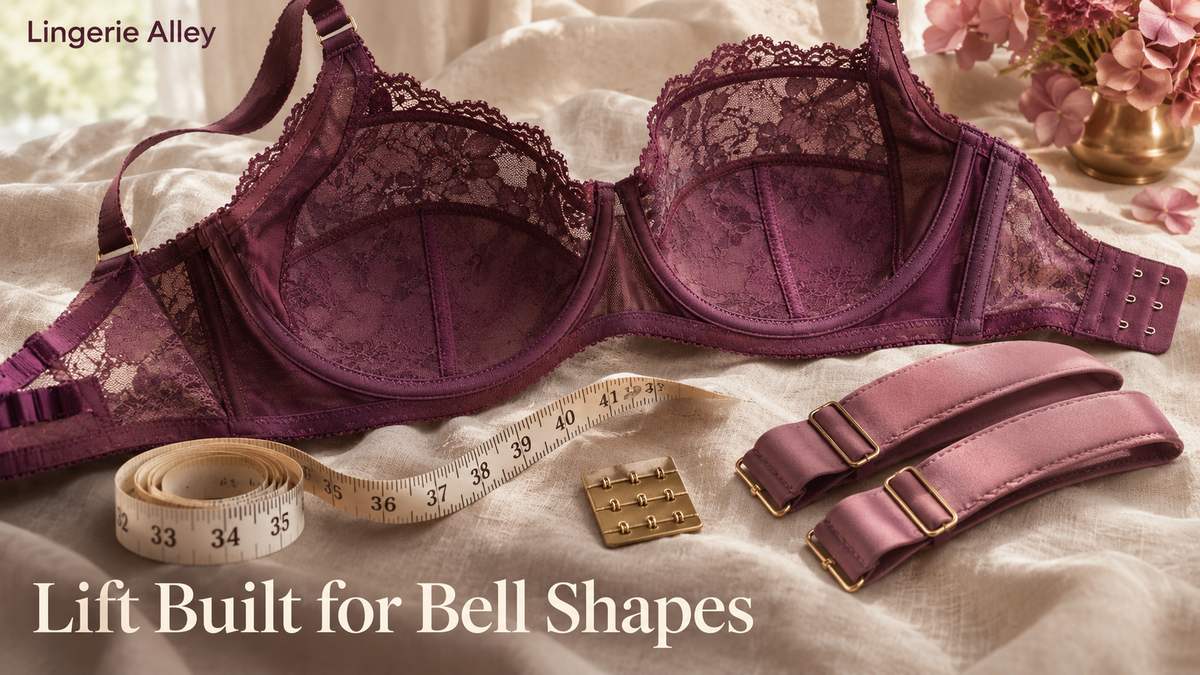
If your bra leaves a red groove on each shoulder by 5 p.m., gaps a little at the top of the cup, and still feels like it is losing a fight at the bottom, the bra is probably not built for where your weight sits. Bell-shaped breasts are narrower at the top and fuller at the bottom, so most of the tissue, and most of the weight, lives in the lower half of the cup. A bra that suits this shape is less about looks and more about load: where the weight goes, what holds it, and what gives way first.
This guide is about that engineering. If you are not sure yet whether bell is your shape, the style quiz has a breast-shape step that walks you through it.
Why a Bell Shape Is a Weight Question
Picture the breast as two halves split by a horizontal line through the nipple. Fitters call the bottom half the lower pole. On a bell shape the lower pole is noticeably fuller than the upper pole, and the upper chest above the breast is often fairly flat.
That has three practical consequences:
- The cup bottom does the heavy work. Weight presses down and forward into the lower cup. A cup made of a single soft layer will stretch there over the day.
- The top of the cup has less to fill. Cups shaped for even, round fullness can gape or wrinkle along the neckline, even when the size is right.
- The band and straps feel the load first. If the band is loose, the straps take over, which is where the shoulder grooves come from.
None of this means anything is wrong with the shape. It just means a bra built around evenly distributed tissue will spend its day being pulled out of shape, and a bra built around a heavy lower pole will not.
The Construction That Carries a Heavy Lower Pole
When you read product pages or turn a bra inside out in a fitting room, these are the details worth checking.
Seamed cups, ideally three-part
A three-part cup is sewn from three pieces: usually two lower pieces joined by a vertical or diagonal seam, plus an upper piece. Those seams are not decoration. Each one is a curve cut to a specific depth, so the cup holds a shape with real volume at the bottom and less at the top, which is close to the bell outline. A vertical seam in particular pushes tissue forward and up instead of letting it settle.
Two-part cups with a horizontal seam can also work, especially when the lower piece is lined with a firm, low-stretch fabric. Molded foam cups are the hardest match, covered below.
A side sling or side-support panel
A side sling is an extra piece of firm fabric sewn inside the lower outer edge of the cup. On a bell shape, tissue tends to drift down and out toward the underarm as the day goes on. The sling acts like a hammock wall: it keeps that tissue pointed forward and gives the lower pole something to rest against. Look for phrases like "side support panel" or "side sling" in the description, or feel inside the cup for a second layer along the outer edge.
Full-length wires that match your root
The wire should trace the full crease under your breast, from the center to the side, and sit flat on the ribcage rather than on tissue. A bell shape can have a fairly wide base under a narrow top, so a wire that is too narrow ends up sitting on breast tissue at the outer side, where it presses and pokes. If you have tried narrow wires and felt them poke, try a different brand or style in the same size before changing size, because wire width varies a lot between brands at the same label.
A firm band with real hooks
The band is where most of the support should come from, which fitters repeat for good reason. For a heavy lower pole, look for:
- A taller band with three or four hooks stacked in each column, which most brands switch to once you are past the smaller cup sizes.
- Firm, close-knit band elastic that springs back when you stretch it, rather than a soft knit that stays stretched.
- A band that stays level from front to back when you raise both arms.
Wide, low-stretch straps
Straps should steady the cup, not carry the bust. Wider straps spread whatever load they do take across more of the shoulder. Many fuller-cup bras use a fully adjustable strap or a section of rigid, non-stretch strap near the cup, which stops the cup from bouncing down when you move. Padded straps are a comfort extra, not a support fix.
Styles That Tend to Struggle
Some cuts work against this shape. That does not mean you can never wear them, only that you should expect a trade-off.
- Molded T-shirt cups. The foam is pre-shaped with even fullness, so the lower cup may not be deep enough while the top stands away from you. The result is the gap at the neckline people often blame on cup size.
- Push-up bras with heavy bottom padding. The pad takes up room in the lower cup that your tissue already needs, which pushes tissue up and over the top edge.
- Unstructured bralettes. Soft lace and a narrow elastic band cannot lift a full lower pole for long. They are fine for lounging, and some longline bralettes with a wider band do better.
- Low-cut demis without seams. The cup simply does not cover enough of the lower pole to hold it.
Balconettes and plunges sit in the middle. A seamed balconette with vertical seams can suit a bell shape well. A plunge with a low gore can work if the cup is deep and seamed, but it is not the place to start.
Five Fitting Tests to Run Before You Buy
Size charts get you close. These tests tell you whether the construction actually works for your shape.
1. Scoop first, then judge
After fastening the band, lean forward slightly and use the opposite hand to lift tissue from the side and bottom into each cup. A bell shape often hides a little tissue under the arm. If the cup overflows after you scoop, it was too small all along. The scoop and swoop method is worth learning properly.
2. The strap drop test
Slide both straps off your shoulders and let them hang. The band should stay level and the cups should still hold most of the weight, with a little sag that is normal. If the band slides up your back and the cups fold forward, the band is too loose or the lower cup has no structure.
3. The lean and look
Bend forward at the waist and look down. Tissue should stay inside the cups and the wire should stay against your ribs. If the bottom of the wire lifts off your body, the cup is too shallow at the bottom.
4. The neckline check
Stand straight and look at the top edge in a mirror from the side. A small gap means the cup is fuller at the top than you are. Try a stretch-lace upper cup, which closes the gap without adding size.
5. The two-hour test
Ten minutes under fitting-room lights tells you little about hour six. If you can, wear the bra around the house with the tags on for a couple of hours. Watch for the band riding up in the back and the straps starting to dig, the two most common late-day signs on this shape.
Bell, Teardrop or Relaxed?
These three get mixed up because all are fuller at the bottom. The difference is degree and texture.
- Teardrop is a gentle lower fullness with a rounded top. It suits most cuts, and choosing is more about the outfit than the engineering. Our guide to bras for teardrop breasts ranks styles that way.
- Bell has a clearly narrower top and a heavier, fuller base. Support construction matters more than cut.
- Relaxed describes softer, more mobile tissue that sits lower on the chest, which can overlap with any shape.
If you want the bust to look more compact under a fitted shirt or button-front blouse, a minimizer is a separate question. Read whether minimizer bras work before buying one, because some redistribute tissue to the sides rather than lifting it.
Frequently Asked Questions
Can a wireless bra support bell-shaped breasts?
Yes, if it borrows the structure of a wired bra. Look for seamed cups, a side sling, a wide band and a firm band of fabric sewn under each cup where a wire would sit. Expect less lift than a well-fitted underwire, and use the strap drop test to check.
Why do my straps keep digging even in the right cup size?
Usually the band is too loose, so the straps carry the weight. Try the next band size down with the cup letter one step up, so a 36D becomes a 34DD, which keeps roughly the same cup volume on a firmer band. If your shoulders feel lighter, the band was the problem. A band that is too old and stretched does the same thing.
Are minimizer bras good for a bell shape?
Some are, because many minimizers use seamed full cups and firm side panels that suit a heavy lower pole. Others mainly press tissue flatter and wider. Check the seams and side panel the same way you would for any support bra.
How often should I replace a bra that carries a lot of weight?
There is no fixed rule, but the band tells you. When it rides up on the loosest hook, or the elastic stays stretched after you pull it, the bra has lost most of its support.
Last tip: own at least two or three bras you rotate, and give each one a day off between wears. Band elastic recovers when it rests, and on a shape that puts steady weight on the band, that rest day is what keeps a good bra good for longer.
Find Your Perfect Fit
Take our 60-second quiz and get personalized lingerie recommendations matched to your body, style, and budget.
Take the Quiz