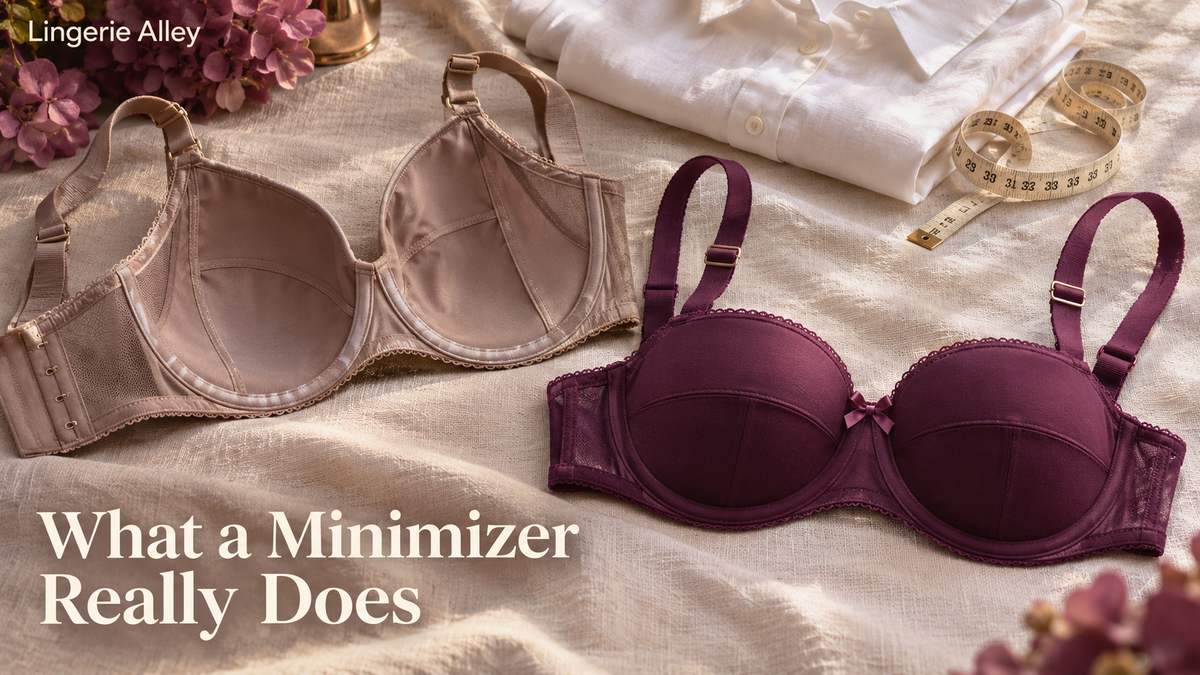
Put on a white button-front shirt, stand side-on to a mirror and look at the space between the second and third buttons. If that placket pulls open in a little oval, you have found the exact problem a minimizer bra was invented for. Not "a big bust", which is not a problem, but a specific fabric behavior: forward projection pushing a woven shirt past what its buttons can hold.
So do minimizer bras work? Yes, at one job. A good minimizer reduces how far your bust sticks forward by spreading the same tissue over a slightly wider and lower area. It does not make your breasts smaller, and the cheaper versions get their result mostly by pressing down. Knowing which kind you are holding is most of the decision.
What a Minimizer Actually Changes
Breast tissue has a fixed volume. Any bra can only change its shape and position. A regular supportive bra usually aims to lift the tissue and bring it forward and slightly toward the center, which gives a rounder, more projected profile. A minimizer aims the other way: it lets the tissue spread a little toward the sides of the chest and keeps the front of the cup shallower.
The measurable change is the tape measured around the fullest part of the bust. Because the profile is shallower, that number can drop. What you see in the mirror is a bust that looks less pronounced from the side and sits closer to the body under clothes. From the front, you may actually look slightly wider at chest level, because the tissue had to go somewhere.
That trade is the honest answer to whether minimizers work. They move projection into width. Whether that looks "smaller" depends on what you are wearing and which view you care about.
Where the tissue goes
Turn a minimizer inside out and you can usually see the plan:
- Wider, shallower cups. The cup is cut with less depth at the apex and more room at the sides.
- Firm side panels or slings. A stable panel along the outer cup lets tissue widen inside the cup while stopping it from drifting back under the arm.
- A full-coverage neckline. The top edge sits high so tissue that is spread outward does not spill over the top.
- Non-stretch or low-stretch cup fabric. Rigid material holds the new shape instead of molding to the old one.
Real Redistribution vs Flattening
This is the distinction most minimizer reviews skip. Two bras can both reduce your bust measurement by a similar amount and feel completely different after eight hours.
A redistributing minimizer
A redistributing minimizer is built like a good support bra with a different target shape. Look for:
- Three-part or four-part seamed cups. Each seam is a shaping line. A vertical seam plus a diagonal or side panel lets the maker control exactly where the volume sits.
- Full underwires that encircle the breast root. The wire should sit on your ribcage behind the tissue at the sides, not on breast tissue. A wire that is too narrow forces tissue forward and defeats the point.
- A gore that lies flat on your sternum. If the center piece hovers, the cups are too small and you are being squashed rather than shaped.
- A firm band with wide hook closures. The band does most of the supporting in any bra, and a minimizer leans on it even harder because its shallow cups are not built to lift.
The result is a smooth, slightly wider shape. It should feel like an ordinary well-fitted bra, just with a lower profile.
A flattening minimizer
A flattening minimizer gets its number mostly by compression. Common tells:
- Molded foam cups with a lot of stretch knit on top. They hold you in rather than giving tissue a place to go.
- Tissue escaping at the top or under the arm. Volume pressed in one place tends to emerge in another.
- Red marks along the top edge of the cup. That edge is working as a strap, not as a neckline.
- Relief the moment you take it off. A redistributing bra is not uncomfortable, it is just firm.
Compression has its uses for a few hours under a structured jacket. As an everyday bra, a flattener tends to feel tight across the chest and can push the bust lower, which looks heavier, not smaller.
A quick fitting test
In the fitting room, put on the minimizer and lean forward to scoop each breast into the cup from the side. Stand up and check three things. First, does the gore touch your sternum? Second, can you run a finger along the top edge without finding a ridge of tissue? Third, look at your side profile: is the apex of the bust at roughly the midpoint between your shoulder and elbow? If it has dropped well below that, the bra is pressing down rather than spreading out.
Who Gets a Better Result From a Balconette
Here is the part that surprises people. Many women who reach for a minimizer would look more compact in a properly sized balconette.
The reason is proportion. When a bust sits low on the ribcage, it visually merges with the torso, and the whole upper body reads as one wide block. Lift the same tissue a couple of inches and two things appear: space between the bust and the waist, and a clearer line under the arm. The bust itself is the same size, sometimes it even projects more, yet the overall figure looks narrower because the waist is visible.
A balconette does this through its construction. The cup usually has a horizontal seam across the lower half, which acts like a shelf, and wide-set straps that pull straight up. Its neckline is lower and more horizontal than a full cup.
You are likely a balconette candidate if
- Your current bra band rides up your back. That is a sign the band is too loose, so the bust is sitting lower than it should. Fix the band size first, then compare.
- Your bust is fuller at the bottom than the top. A shelf seam lifts a full lower half well. If yours is narrow on top and heavy below, our guide to bras for bell-shaped breasts covers the support side in more detail.
- Your main concern is how you look in knit tops, dresses and fitted tees. Stretch fabrics follow your shape, so a lifted shape reads better than a flattened one.
- You have firm or moderately firm tissue. It holds the lift a balconette creates.
A minimizer still wins if
- Your concern is a button-front shirt or a fitted blazer. Woven fabric does not stretch, so less projection directly means less gaping.
- Your bust projects far forward from a narrow base. A balconette can exaggerate that shape. A minimizer softens it.
- Your tissue is soft and wants to spread anyway. Many people with softer tissue find a seamed minimizer comfortable because it works with how the breast already moves.
- You want high coverage. Minimizers are full-cup by design, which some people simply prefer.
If you are not sure which shape you have, the style quiz asks about breast shape before it suggests any bra, and it will steer you toward a cup style rather than a single product.
How to Shop for a Minimizer That Does Its Job
Start with your real size
Most minimizer disappointment comes from the wrong size, not the wrong bra. A cup that is too small cannot redistribute anything, it can only press. A band that is too loose lets everything sink. If your last fitting was years ago, measure again before buying. Minimizers are commonly sold in a wide range of full-bust sizes, including larger bands, which matters if you also wear plus-size clothing. Our guide to lingerie for plus-size women covers band comfort and strap width at those sizes.
Read the cup, not the label
"Minimizer" is a marketing word, not a construction standard. Check:
- Seams: seamed cups usually redistribute better than smooth molded ones.
- Cup fabric: a rigid outer layer holds shape, a very stretchy one compresses.
- Side panel: look for a separate, firmer piece at the outer cup.
- Straps: wider straps that sit closer to the center of the shoulder spread the load. They help, but the band should still do most of the work.
Test it in your hardest outfit
Bring the shirt or dress that gapes. Wear the bra with it in the fitting room, or try it at home with tags on. Button it, raise your arms, sit down and twist. The point is not whether the bra looks smaller on its own, it is whether that specific garment now lies flat.
Frequently Asked Questions
How much smaller will a minimizer make my bust look?
It varies with your tissue, the bra's construction and how you measure. The reduction is in forward projection, so you will notice it most in a side view and under button-front clothing. From the front, the bust may look the same width or slightly wider.
Are minimizer bras bad for you?
A well-fitted minimizer is a firm full-coverage bra and has no special risk. A badly sized or heavily compressive one can be uncomfortable, dig in at the top of the cup or leave marks, which is a sign to change size or style rather than to put up with it.
Can I wear a minimizer every day?
Yes, if it redistributes rather than flattens. If you feel relief the moment you unhook it, or see red lines along the top of the cup, it is compressing you and is better kept for specific outfits.
Is a minimizer the same as a sports bra?
No. Compression sports bras also press tissue against the chest, but their job is to limit movement during exercise. A minimizer is an everyday bra shaped for a lower profile under clothes and is not designed to control bounce.
Do minimizers come in plunge or low-cut styles?
Rarely. Spreading tissue outward needs a high, full neckline to hold it, so most minimizers have more coverage than a plunge. For a deep neckline, a well-fitted balconette or plunge in your correct size is the usual choice.
Before you buy anything, try this: put on your best-fitting current bra, button the gaping shirt, and tighten the band one hook or shorten the straps slightly. If the gap closes, your answer may be a firmer fit rather than a different style of bra.
Find Your Perfect Fit
Take our 60-second quiz and get personalized lingerie recommendations matched to your body, style, and budget.
Take the Quiz