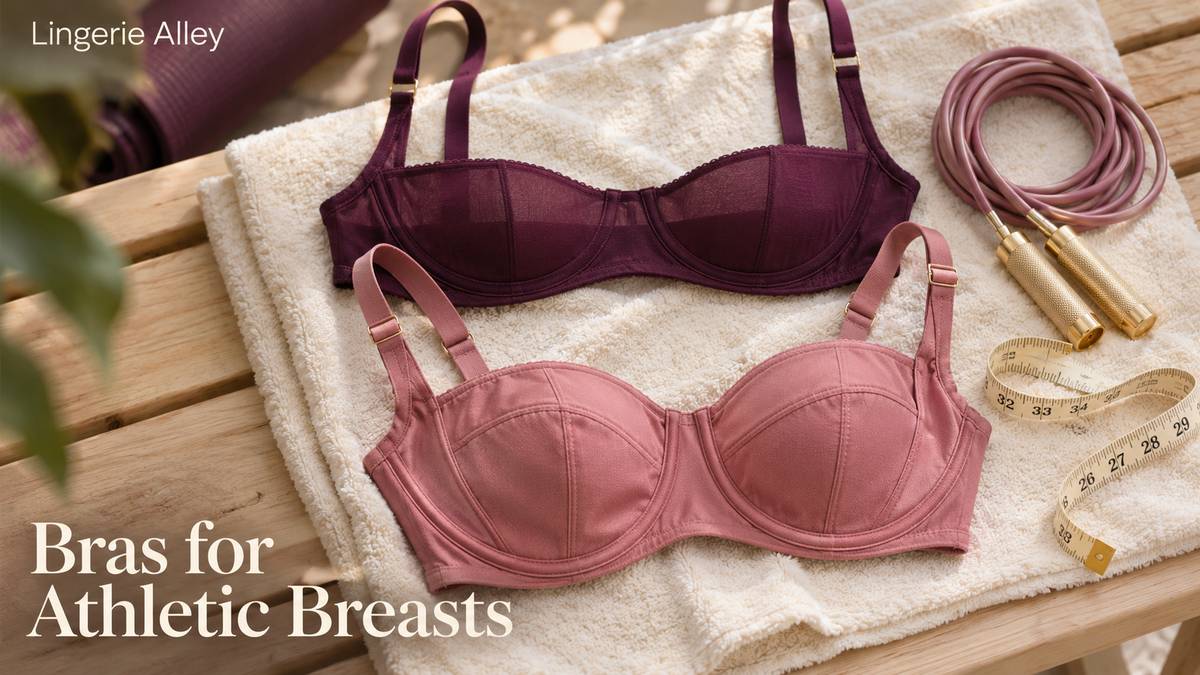
Put on your current bra, raise both arms straight overhead, then lower them. If the wires have slid up onto your chest wall, or the sides now sit on the muscle under your armpit instead of behind your tissue, you have met the main fitting puzzle of an athletic breast shape. The tissue is spread wide across a broad, firm chest, it has less depth than its width suggests, and the muscle underneath moves every time you do.
This article is about that breast shape, not the whole-body silhouette. For a straight or broad-shouldered frame in general, including bottoms and bodysuits, see our guide to lingerie for athletic and rectangle body types. Here the focus is wires, cups, gores and bands.
What "Athletic" Means as a Breast Shape
Fitters use the term for a combination of traits that often show up together, whether or not you train:
- A wide base. The breast root, where tissue meets the chest wall, runs a long way across, often starting near the sternum and finishing well toward the underarm.
- Firm, dense tissue. Breasts hold their shape when you lean forward rather than falling into the cups.
- Low to moderate projection. Seen from the side, the breasts are broad rather than deep. They take up chest space more than forward space.
- A muscular or broad ribcage underneath. Developed pectoral and latissimus muscles change the surface a bra sits on, making it flatter in front and wider at the sides.
You can have some of these without the others. A wide base with soft tissue behaves more like a shallow or relaxed shape. Wide spacing with a large gap at the sternum is its own issue, and our guide to bras for wide-set breasts handles that gap specifically. What makes the athletic shape distinct is the mix of width, firmness and a moving muscular base, all at once.
A two-minute check at home
Stand side-on to a mirror without a bra and look at the profile. Then face forward and trace your breast root with a fingertip, from the center of your chest to the side. If the root is long, the profile is broad and fairly shallow, and the tissue does not change much when you bend at the waist, you are in athletic territory. The style quiz has a breast-shape step that asks the same questions and narrows the results to cuts that suit the answer.
Why Standard Bras Misfit Athletic Breasts
Most mass-market bras assume a medium root width, moderate projection and soft tissue. Each assumption fails differently here.
Wires that are too narrow
Within a brand, wire width grows with the cup letter. Shallow tissue spread over a long root holds modest volume for its width, so the cup letter that matches your volume often comes with a wire narrower than your root. The wire ends sit on breast tissue at the side instead of behind it. You feel it as a pinch under the arm, or you see a ridge where the wire presses into tissue.
Cups that are too deep
The same volume spread wide means less depth. A deep, rounded molded cup leaves a hollow at the apex or along the top edge, so the cup wrinkles or dents. Going down a cup size to remove the hollow usually narrows the wire too, which brings back the side pinch.
Gores that are too tall
A tall center gore, the panel between the cups, has to tack flat against your sternum. Developed pectorals can stand slightly proud of the breastbone, leaving a shallow dip in the middle. A tall gore bridges that dip and lifts away. A lower gore has less distance to bridge and usually lies flatter.
Bands that ignore the lats
Developed back muscles widen the ribcage under your arms, especially when engaged. A band that feels snug while you are relaxed can feel tight as soon as you reach for something. Rigid, narrow bands also tend to roll on broad backs.
The Construction That Fits
Look for these features in roughly this order. Width comes first because nothing else works until the wire sits on your root.
Wide, low-sided wires
You want a wire that follows the whole root and ends behind the tissue at the side. Two details matter:
- Width. Compare the wire to your root by holding the bra up to your bare chest before you try it on. The wire's outer end should reach the point where tissue stops near your underarm.
- Side height. Wires that run high up the side can dig into the front edge of your lats or chest muscle, especially if you train. A wire that is wide but lower at the sides, as many balconette and half-cup styles use, often avoids that pressure.
Shallow, open-topped cups
Shallow cups give the broad base room without the depth it does not need. These cuts tend to work:
- Balconettes and half-cups with a horizontal top edge. The open neckline means there is no upper cup to gape.
- Seamed cups, built from flat panels. The seams set the curve, so a maker can cut them wide and shallow, and fabric flexes where foam would not. Three-part cups (a vertical seam plus a side panel) can follow a firm, wide shape closely.
- Stretch lace or stretch mesh at the top edge, which shrinks back to meet the tissue instead of standing off it.
Deep molded T-shirt cups are the cut most likely to dent. If you love a smooth look under fitted tops, try a thin spacer foam cup, which is softer and flexes more than thick molded foam. Our comparison of unlined and padded bras explains how each kind of cup behaves.
A low, wide gore
A short gore, around an inch or less in height, settles into the center of a muscular chest more easily. If your roots also start a little apart, a gore that is wide as well as low fills that space. Plunge bras have the lowest gores, but their angled cups push tissue toward the center and inward, which suits close-set or soft tissue better than wide, firm tissue. A low-gore balconette usually gives you the short gore without the angle.
A band with stretch and width
- Wider bands with three or more hooks spread pressure across a broad back and roll less.
- Soft, plush elastic at the lower edge feels kinder during movement than narrow, rigid elastic.
- Wings that angle up at the sides clear the lats better than straight wings.
Fitting Tests for an Athletic Chest
Do these in the fitting room or at home before you remove tags.
- The arms-up test. Raise both arms overhead, then lower them. The wires should come back down to the same place. If they stay up on your chest, the band is too loose or the wire too narrow.
- The reach test. Reach forward as if for a coffee cup across a table. A band that fits a muscular back should stay snug without biting.
- The side check. Run a finger along the outer wire under your arm. You should feel the wire end on ribcage, not on tissue or on the front edge of muscle.
- The profile check. Look side-on. The top edge should meet your chest without a ridge or a gap. A dent at the apex means the cup is too deep for you, even if the volume is right.
- The flex check. Squeeze your shoulder blades together, then push your palms together in front of your chest. The gore should stay close to your sternum.
If a bra passes the first three and fails the profile check, keep the size and change the cut. If it fails the side check, look for a wider wire before you change sizes.
When Training Changes Your Fit
Muscle and body composition shift with training, and bras that fit in one phase may not fit in another. A heavy strength block can widen your back. A long endurance phase can reduce breast volume while leaving the ribcage the same. Neither is something to correct. A bra size is a snapshot of one season of training.
Three habits help. Measure your band at a consistent time, ideally on a rest day and not straight after a session, when muscles can be a little fuller. Buy new bands on the loosest hook so you have room to tighten as the elastic relaxes or to loosen if your back grows. And when you find a bra that passes the side check, write down its wire style and cup construction, not just the size on the tag. Those two details carry across brands far better than the letter does.
Frequently Asked Questions
Can you have an athletic breast shape without exercising?
Yes. The name comes from the look, not from a workout history. A wide root, firm tissue and broad, shallow profile can occur on any frame, and plenty of people with this shape do not train at all. Fit them the same way.
Should I size down in the cup if the top of the cup gapes?
Usually not as a first step. Gaping on an athletic shape tends to come from cup depth, not volume, and sizing down often narrows the wire too. Try the same size in an open-topped balconette or a seamed cup before you change the letter.
Are wireless bras a good option for athletic breasts?
They can be, especially for firm tissue that holds its shape without a wire. Look for wide side panels and a broad band so the bra still frames the full root. A wireless bra with a narrow, scooped side may leave tissue loose under the arm.
Do athletic breasts need a different band size than my measurement says?
Your tape measurement is still the starting point. Broad backs and developed lats can make a firm band feel tighter than expected during movement, so it is worth trying your measured band alongside one sister size up and comparing them with the reach test. If you go up a band, go down a cup letter to keep the same cup volume, for example 34C to 36B.
Before Your Next Fitting
Take one bra you already own that nearly works to the fitting room and run all five tests on it first. Whichever test it fails tells you which single feature to change, wire width, cup depth, gore height or band, which narrows the rack before you start.
Find Your Perfect Fit
Take our 60-second quiz and get personalized lingerie recommendations matched to your body, style, and budget.
Take the Quiz