Lay two fingers flat against your sternum, between your breasts, with no bra on. If both fingers fit side by side on bare skin without touching breast tissue, your breasts are wide-set. Everything below follows from that gap: where your breast tissue begins on your chest wall, which fitters call the root, and not which way your nipples point.
That distinction matters because most advice for wide-set breasts is really advice for a different shape. Push-up pads and "bring them together" plunges get recommended for both, and they work for some people and fail for others. Once you know the problem is spacing, the fix becomes a question of wires, gores and side panels, and you can check all three in a fitting room in under a minute.
Wide-Set or East-West? A Quick Way to Tell
These two get mixed up constantly, and plenty of people are both. Try this in front of a mirror, without a bra:
- Measure the gap. Two or more fingers of bare sternum between the inner edges of your breast roots points to wide-set.
- Look at the direction. Stand straight and look at where your nipples point. If they angle toward the walls rather than straight ahead, that is east-west.
- Check the outer edge. Run a finger along where each breast meets your side. With wide-set roots, tissue often starts close to the underarm, so the outer root sits further back than you expect.
Wide gap, forward-pointing nipples: wide-set. Normal gap, outward-pointing nipples: east-west, and our guide to the best bras for east-west breasts covers the angled padding and plunge cuts that suit that shape. Wide gap and outward direction: you are both, so start with the spacing advice here, because a bra that does not sit at your roots cannot redirect anything.
If you are still unsure, our breast shape guide walks through the full set of shapes with side-view checks.
Why Standard Bras Misbehave on Wide Roots
A typical underwire is designed around an average root width for its cup size. When your roots sit further apart, two things happen, and they happen at the same time.
First, the inner end of the wire lands where there is no tissue, which is harmless, but the cup above it has nothing to fill it. You see a hollow, sometimes a wrinkle, along the inner neckline.
Second, and more uncomfortable, the outer end of the wire stops short of your outer root. It ends up sitting on breast tissue at the side instead of on your ribcage behind it. That is the classic sore spot under the arm, and it often gets misdiagnosed as a cup that is too small. Going up a cup size sometimes helps only because larger cups usually come with longer wires, and you end up with extra empty volume at the top as the trade.
So the target is a bra whose wire is wide enough to reach your outer root, positioned so the cups line up with where your tissue actually starts.
The Three Construction Details That Fit Wide Roots
Wide wires
The underwire is the single most important part. Look for bras described as having wide or "wider" wires, which some brands mention in product notes and many fit reviewers measure. You can test it yourself without a description:
- Put the bra on and lean forward to settle tissue into the cups.
- Stand up and press along the wire under your arm.
- You should feel the wire on rib, behind all breast tissue. If you feel soft tissue outside the wire, it is too narrow for you.
Wire width also varies by cup style within the same brand. Balconette and half-cup wires tend to be wider and shallower, plunge wires tend to be shorter on the inner side, and full-cup wires are often taller on the outer side. Try more than one style before deciding a brand doesn't work.
A gore that matches your gap
The gore is the center panel between the cups. On wide-set breasts it should sit flat against your sternum, and its width should roughly match your gap. Two common options work:
- A wide gore. A broader center panel puts each cup further out, so the wires land at your roots. Compare gores side by side on the hanger; the difference between styles is easy to see. If the gore lies flat and the inner cups are filled, this is a strong fit.
- A low gore with wide-placed cups. Some plunges have a short gore but cups angled outward from it. Height is less important than width here. A plunge only works if the cups still begin where your tissue begins.
What tends to fail is a plunge with a narrow, low gore that pulls the cups toward the center. It leaves the inner cups empty and drags the outer wire onto tissue at the side. A narrow plunge is popular advice for wide-set breasts, so this is worth testing for yourself rather than assuming.
Side-support panels
A side-support panel, sometimes called a side sling, is an extra layer of firm fabric sewn inside the outer part of the cup. It cradles tissue from the outside and nudges it forward and toward the center. On wide-set breasts with tissue close to the underarm, it does two useful things: it keeps that outer tissue inside the wire, and it brings the visible shape closer to center without padding.
Seamed cups help here too. A three-part cup, with a vertical or diagonal seam on the outer section, has more room and structure at the side than a one-piece molded cup. If your molded T-shirt bras always feel shallow at the outer edge, try a seamed version of the same size.
Cuts That Usually Work, and What to Expect
With those details in mind, here is how common cuts tend to behave on wide-set roots. Treat it as a starting order, not a rule.
- Full-cup or three-part seamed bras with a wide gore. The most reliable starting point. They fit the spacing as it is and support the outer tissue well.
- Balconettes. Wide, shallow wires are common, which suits wide roots. The open top can gape if you also have little upper fullness.
- Side-support T-shirt bras. A smooth option under knits if the molded cups are wide enough at the outer edge.
- Wide-placed plunges. Good for low necklines, as long as the cups start at your roots. Check the inner cups for hollows.
- Wireless bras with wide-set cups. Bralettes have no wire to land in the wrong place, so they are often comfortable. Look for separate cups rather than one continuous triangle, which lets each cup sit over its own breast.
About cleavage: a bra that fits wide-set breasts will usually show a gap at the center. That is the bra fitting you correctly. If you want closer cleavage for a particular outfit, a push-up with inner-edge padding can do it, and that is a style choice for the day, not a fit fix.
A Fitting-Room Checklist
Take this with you, phone in hand. A bra that passes all five is worth buying.
- Band level and snug on the loosest hook. The band does most of the support work, and nothing above it settles right if it rides up.
- Gore flat on the sternum. Slide a finger under it. It should touch skin along its length without digging.
- Outer wire on rib. Press under your arm. No soft tissue outside the wire.
- Inner cups filled. Look in the mirror for hollows or wrinkles near the center. Small gaps on a stiff molded cup are normal, but a fold in fabric means the cup sits in the wrong place.
- Raise your arms and twist. If the wire shifts onto tissue at the side, the wire is too narrow or the band is too loose.
Our style quiz asks about breast shape as one of its eight steps and weighs it when it suggests bra subcategories, so it is a quick way to narrow a long list before you shop.
Frequently Asked Questions
Are wide-set breasts uncommon?
No. Breast spacing varies a lot from person to person, and a noticeable gap at the sternum is a normal variation. It is also common for the two sides to be slightly different, so fit the bra to the side that needs more room.
Can I wear a regular push-up bra if my breasts are wide-set?
You can, and many people do for specific outfits. Check the outer wire first, though. If the push-up pulls the cups toward the center, the wire may land on tissue under your arm, which gets sore by the end of the day.
Should my bra gore touch my chest if I have wide-set breasts?
Ideally yes. A gore that lies flat on your sternum shows that the cups are positioned at your roots. If it floats away from your chest, the cups may be too small, or the wire too narrow, pushing the center forward.
Does my bra size change if my breasts are wide-set?
Your band and cup size come from your measurements and how the bra fits, not your spacing. What changes is which styles fit you in that size. You may find you wear one size in a wide-wired brand and need a different one in a narrow-wired style.
One Last Tip
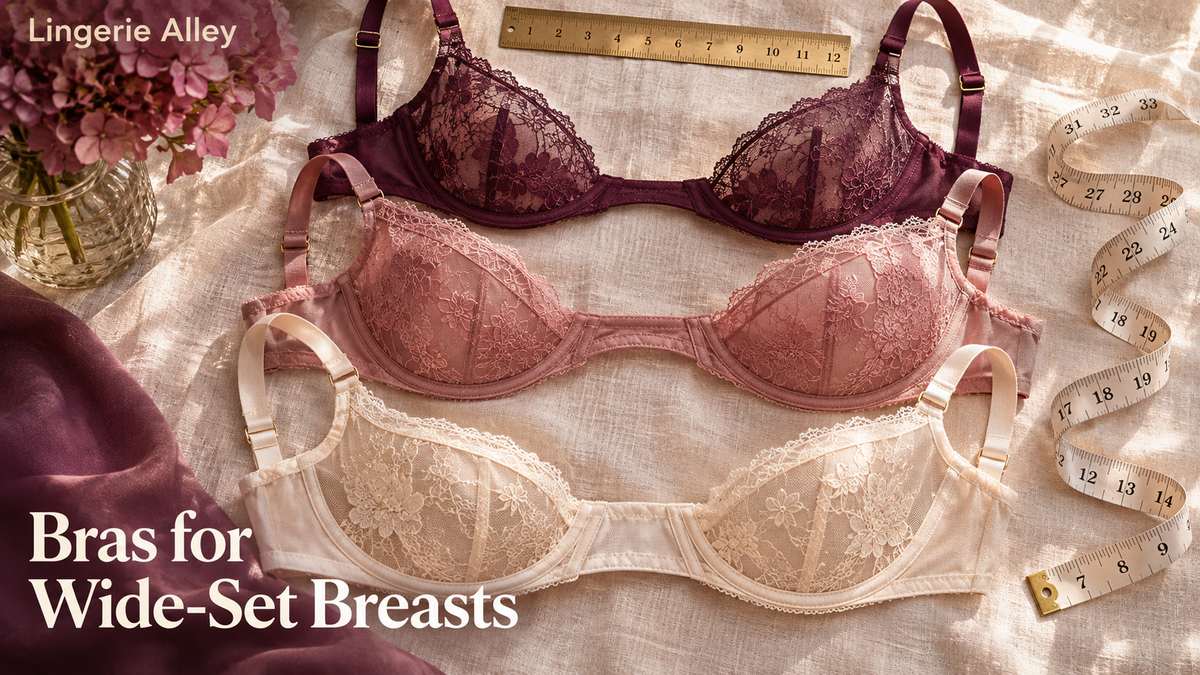
Keep the bra that fits you best, even when it wears out. Lay it flat and measure the gore width and the distance between the wire ends with a ruler. When you shop online, compare those numbers against product photos or reviews that mention wire and gore width, and you will skip most of the bras that were never going to sit on your roots.
Find Your Perfect Fit
Take our 60-second quiz and get personalized lingerie recommendations matched to your body, style, and budget.
Take the Quiz