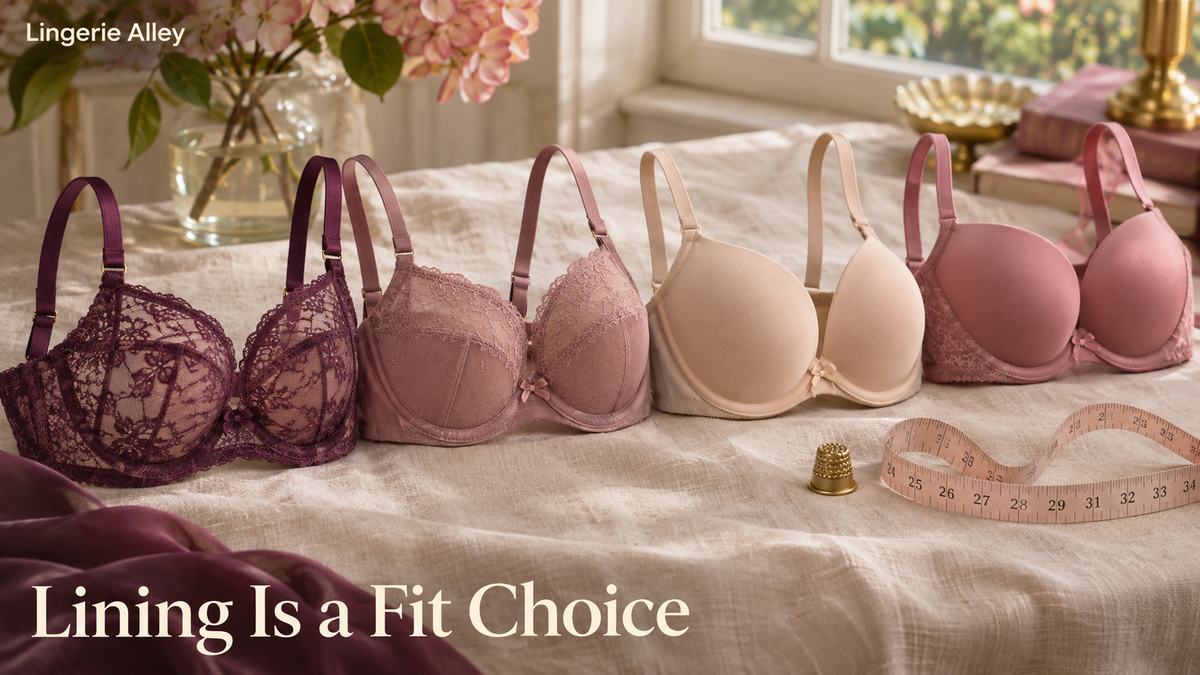
Set a molded T-shirt bra and an unlined lace bra on a table, cups up. The molded one holds a perfect dome with nobody in it. The lace one slumps a little, or stands up in a shape made of seams. That difference is the whole story. A foam cup arrives with its shape already decided, and an unlined cup gets most of its final shape from you.
Most advice about lining talks about nipples, modesty and what shows under a white shirt. Those are real concerns, and we cover them in our guide to lingerie under white. This article is about something that gets less attention: lining changes which bodies a bra can fit. If a bra has never quite worked on you, the cup lining may be the reason, and switching lining types can solve what switching sizes never did.
What "Lined" Actually Means: Four Cup Types
Labels are loose, so it helps to know what is inside the cup rather than what the tag says.
Unlined
One or two layers of fabric and no foam. The fabric might be rigid lace, power mesh, microfiber or tulle. A second layer of sheer mesh is common and still counts as unlined. The cup gets its shape from seams: a vertical seam, a three-part cup with a horizontal seam across the lower half, or four or more pieces in fuller cup sizes. Some unlined cups are cut from stretch lace with no seams at all, and those shape themselves almost entirely to the wearer.
Lightly lined
A thin layer, a few millimeters at most, of foam or spacer fabric. It comes in two main builds:
- Cut-and-sew foam: thin foam cut into pieces and sewn together like an unlined cup, so it keeps the seam shaping but adds smoothness.
- Spacer fabric: a three-dimensional knit with air between two faces. It is lighter and more breathable than solid foam, though spacer cups are usually molded too, so the shape is fixed, just softer and more forgiving than thick foam.
Molded or contour
Foam heat-pressed over a form into one seamless piece. This is the classic T-shirt bra. The foam may be thin, but the shape is fixed by the mold, and that is what matters for fit.
Padded and push-up
Thicker foam, often graduated, meaning it is thicker at the bottom and outer edge so it moves tissue up and in. Some use removable pads, gel or air inserts. The shape is fixed, and it is also built to add volume in specific places.
Why Molded Cups Fit Fewer Shapes
A molded cup is a single guess about what a breast looks like. Each manufacturer has its own forms, but most aim for a rounded dome with moderate depth and fullness spread evenly from top to bottom. If your shape matches that dome, a molded cup is excellent: smooth, supportive and easy to wear. If it doesn't, the cup has no way to meet you halfway.
That rigidity shows up in a few predictable ways:
- Gaps at the top edge. When tissue sits lower or the breast is less full on top than the mold expects, the upper cup stands away from the chest. Sizing down to close the gap usually makes the wires sit on tissue at the sides.
- Dents and creases at the front. When the breast is deeper than the mold, the tissue pushes into the cup and the foam folds. You see a dent across the cup or a visible ridge under a fitted top.
- Cut-in at the neckline. When fullness sits high, the firm foam edge presses a line into the upper breast, because foam cannot stretch the way a lace edge can.
- Uneven sides that show. Many people have one breast larger than the other. A molded cup holds its shape either way, so the smaller side tends to gape while the larger one fills.
Seamed unlined cups work the opposite way. The pattern sets a range, and your tissue settles the rest. A three-part cup can be cut deep and narrow for projected breasts, or with a short, open upper cup for a shallow shape. Stretch lace upper edges soften around fullness at the top. Small fit errors that would leave a hollow in foam often disappear in fabric, because the fabric simply lies against you.
That makes a seamed cup the sensible first try when you are unsure of your shape. Once you know which seamed cup fits, you have a reference point for judging whether a particular mold matches.
Matching Lining to Breast Shape
Shape is a better guide than cup size here. The style quiz has a breast shape step if you are still working out which description fits. In general terms:
- Projected or conical: deep seamed cups, unlined or cut-and-sew. Molded domes are usually too shallow at the apex. Our guide to bras for projected breasts goes into seam types and testing.
- Slender: narrow at the root and longer than it is full. A molded cup often leaves hollow space at the bottom and top. Lightly lined plunges and stretch lace tend to sit closer; see bras for slender breasts for the details.
- Round, evenly full: the shape most molds are built around. Molded and padded cups often work straight off the rack.
- Shallow: tissue spread wide and close to the chest. Shallow molded cups and lightly lined balconettes can fit well, while deep seamed cups may wrinkle at the top.
- Relaxed or softer tissue: seamed cups with a rigid, non-stretch lower cup gather and lift tissue from below. Soft stretch unlined cups give way here, so check the fabric. Molded foam tends to let softer tissue settle low and leave the top hollow.
- Full on top: stretch-edged unlined cups or lightly lined styles with a lace top band. A rigid foam edge is the one most likely to cut in.
None of these are rules. Molds vary a lot between brands, and plenty of projected women own one molded bra that happens to suit them. Treat the list as a starting point for what to try first.
How to Test Each Type in the Fitting Room
Different linings fail in different ways, so the checks are slightly different.
For molded and padded cups
- Put the bra on and scoop all tissue into the cups from the sides.
- Look at the top edge from the side in a mirror. It should lie flat against you with no gap and no line pressed into skin.
- Press gently on the front of each cup. If the foam collapses inward, there is empty space behind it.
- Pull on a thin, close-fitting T-shirt. A ridge or dent across the cup means the mold is the wrong depth.
For unlined and seamed cups
- Check where your nipple sits relative to the seams. It should land at the fullest part of the cup, not pressed against a horizontal seam.
- Look for wrinkles in the fabric. Loose fabric at the apex means the cup is too deep; loose fabric along the top means the upper cup is too tall for your fullness.
- Lean forward and stand back up. The cup should still hold you without spilling at the top edge.
For both
The band does most of the support work, whatever the cup lining. Fasten on the loosest hook, check that the band sits level, and confirm the center gore lies against your sternum. A cup can only fit properly once the band is right.
When Padding Is Still the Right Call
Choosing unlined for fit does not make padding a bad choice. Padding does real work:
- Shape under smooth fabrics. A molded cup gives one clean line under jersey, silk and tight knits. If your shape matches the mold, nothing else does this as well.
- Volume on purpose. Push-up and graduated padding add fullness where you want it. That is a style decision, and a fair one.
- Evening out asymmetry. A cup with a removable pad lets you take the pad out on the larger side only, which can balance the silhouette.
- Preference for a layer. Some people simply like the feel of foam between skin and shirt, and that is reason enough.
A lot of wardrobes end up with both: unlined or seamed bras for most days because they fit, and one or two molded bras in a mold that actually suits the wearer for specific outfits.
Frequently Asked Questions
Is an unlined bra less supportive than a padded one?
Not usually. Support comes mostly from the band and, in underwire bras, from the wire and the lower cup. A well-made seamed unlined cup in rigid fabric can lift and hold more firmly than a soft molded cup, especially in fuller cup sizes.
Does a padded bra change my bra size?
The size on the tag should not change, but different lining types from the same brand can fit differently. Padded and push-up cups take up some internal space, so some people go up a cup in heavily padded styles. Try both sizes rather than assuming.
Can I take the padding out of a bra?
Only if the pads are removable inserts sitting in a pocket. Molded and cut-and-sew foam is built into the cup and cannot be removed without ruining the shape. Removing an insert often leaves a cup that is slightly too large.
How do I know if a cup is cut-and-sew foam or molded?
Look for seams. Cut-and-sew foam has visible seam lines across the cup, often with seam tape on the inside, while a molded cup is one smooth piece.
Are unlined bras good for small cup sizes?
They often are. Small cups made from stretch lace or soft mesh can fit closely with no empty space, which is hard to manage in a molded cup that expects more volume. Lightly lined plunges are another good option if you want a smooth line under shirts.
Next time a molded bra almost fits, try the same brand's seamed or lightly lined version in the same size before going up or down a cup. If the lined version sits better, you have learned something about your shape that a size label could never tell you.
Find Your Perfect Fit
Take our 60-second quiz and get personalized lingerie recommendations matched to your body, style, and budget.
Take the Quiz