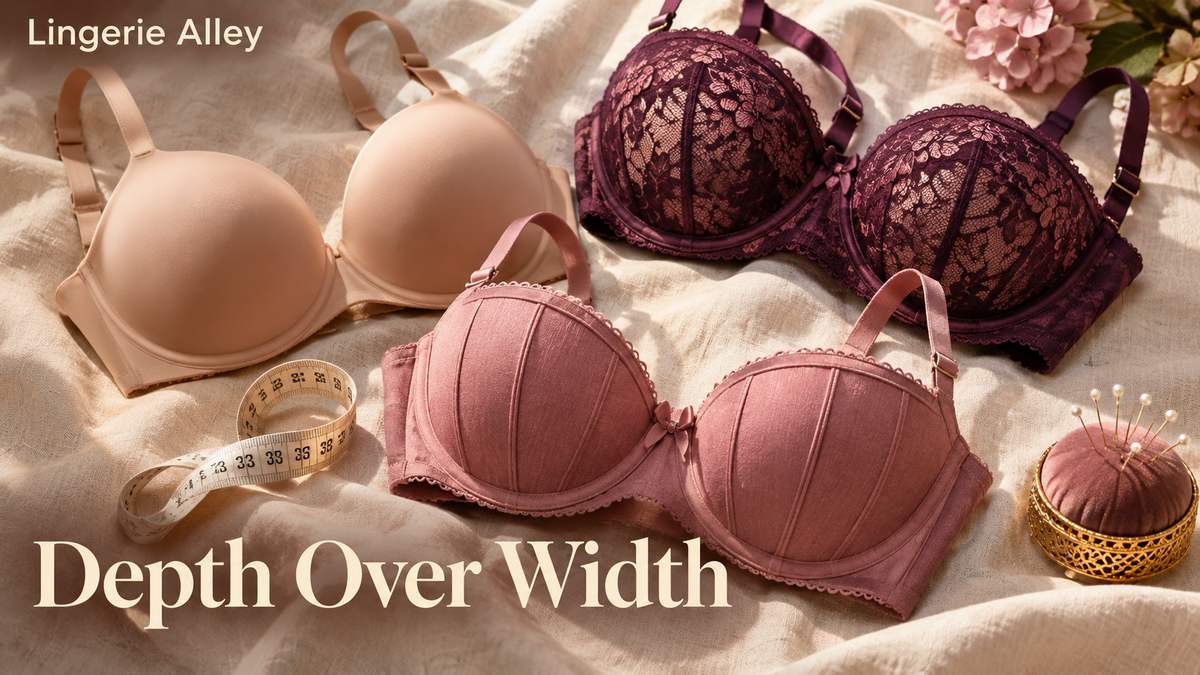
Stand side-on to a mirror in a well-fitting band and look at how far your breasts come forward compared with how wide they are where they join your chest. If the distance forward is the bigger number, you have projected breasts. If they also narrow toward the front, a little like a cone rather than a dome, fitters call the shape conical. Both have the same practical consequence: you need cup depth more than cup width, and a lot of bras on the market are built the other way around.
That mismatch explains a bra that somehow feels both too small and too big at once. The cup is too shallow at the apex and too wide at the base. The fix is not usually a different size. It is a different kind of cup.
What Projected and Conical Actually Mean
Two measurements describe a breast for bra purposes: the root, which is the footprint on your chest wall, and the projection, which is how far the tissue extends forward from it. A projected breast has a lot of projection for its root. A conical breast is a projected breast whose volume tapers toward the nipple instead of rounding out evenly.
This is a shape, not a size. A 32B can be projected, and so can a 34G. It is also the mirror image of a shallow shape, where the root is wide and the tissue sits close to the chest, leaving the top of the cup empty. If that sounds more like you, our guide to bras for shallow breasts covers the opposite set of fixes. If you are still working out which description fits, the breast shape step in the style quiz lets you pick projected or conical and tilts product results toward deeper seamed cups.
A quick self-check:
- Stand side-on to the mirror with no bra on and look at the profile. Projected breasts read as a point or a cone well forward of the chest, rather than a low curve that stays close to it.
- Put your fingertips where the underwire would sit at each side. If the tissue starts well inside the line of your armpits, your roots are on the narrow side.
- In a molded bra, look for a crease or dent across the front of the cup, or a cup edge that presses a line into the tissue near the top. Both are signs of more depth than the cup can hold.
Why Molded T-Shirt Bras Fail This Shape
A molded cup is a single piece of foam heat-pressed over a form. The form decides the shape, and most forms are a fairly shallow, rounded dome, because that shape looks smooth on the hanger and under a T-shirt. The cup does not change shape to meet you. You either fill it the way the form expects, or you don't.
When a projected breast goes into a dome-shaped molded cup, one of three things happens:
- The tissue gets flattened. The breast is pushed back toward the chest, the volume has nowhere to go, and it spreads to the sides or under the arms. The bra looks fine, but you feel pressed.
- The cup edge cuts in. Because the apex of the cup is too shallow, the tissue fills it and keeps going, and the top edge of the cup digs a line across the breast. It looks like the cup is too small, so the instinct is to size up.
- Sizing up makes it worse in a different way. A bigger molded cup is also wider at the base. Now the wires sit too far out on a narrow root, the sides gape, and the bra still dents at the front because the extra volume went into width, not depth.
Some molded bras do work, usually ones described as "deep" or "full" cups, or brands whose molds run narrow and tall. They are the exception, so treat a molded bra as something to test, not the default.
The Construction That Fits Projected Breasts
Seamed cups
A seamed cup is cut from flat pieces of fabric or foam and sewn together, and every seam is a chance to add depth exactly where it is needed. That is why fitters reach for seamed cups first for projected shapes.
- Vertical seam: one seam runs from the bottom of the cup up toward the strap. It creates forward projection and a slightly lifted, rounded profile. Good for moderately projected breasts.
- Three-part cup: a vertical seam plus a horizontal or diagonal one, so the lower cup is two pieces and the upper cup is one. This gives the most control over depth at the apex and is often the best match for conical shapes.
- Four-part or multi-piece cups: more seams, more shaping, usually found in larger cup sizes where the cup also has to carry weight.
The seams themselves are the thing to examine. A cup with a deep curve sewn into the lower pieces will stand up on its own when you set the bra on a table. If the cup lies flat, it is built for a shallower shape.
Unlined and lightly lined fabrics
Unlined seamed cups in rigid lace, mesh or microfiber follow a projected shape closely, because there is no foam to resist the tissue. Cut-and-sew foam, which is thin foam sewn in seamed pieces, gives some of the smoothness of a molded cup while keeping the depth. If you are weighing the two, unlined vs padded bras explains how lining changes fit for different shapes.
Under a thin knit, unlined seams can show. A cut-and-sew foam cup or a smoothing camisole over the bra solves that without going back to a molded cup.
Narrow wires
A narrow root needs a narrow wire. When the wire is too wide, it sits on bare ribcage at the sides and the cup has spare fabric at its base, which is the same gaping you would see in a cup that is too big. Look for a wire that ends roughly where your breast tissue ends under your arm, not past it.
Cut and style
- Full cup and three-part balconette styles tend to have the most depth.
- Plunges can work if they are seamed, since a plunge built on a molded form often has very little depth at the apex.
- Soft cups and well-structured bralettes in stretch fabric adapt to projection, which makes them a comfortable option for smaller projected sizes or for days off from wires.
Fitting Tests in the Fitting Room
Bring a thin, fitted top. Fasten the bra on the loosest hook, then do these checks in order.
- Scoop and settle. Lean forward, reach into each cup and bring tissue from the sides and underneath into the cup. Stand up. Projected breasts often look like they fit before the scoop and then overflow after it, which tells you the cup is too shallow.
- Find the apex. The fullest point of your breast should sit at the fullest point of the cup. If it sits above it, or pushes against a seam that is too low, the cup's depth is in the wrong place.
- Check from the side. Turn sideways. The front of the cup should be smooth, with no crease or flattened area across it. A slight point in a seamed bra is normal and is just the shape of your breast.
- Trace the wire. Run a finger along the wire at each side. It should rest on your ribcage just behind the tissue, not on breast tissue and not out on bare ribs.
- Put the top on. Look for edge lines and seam ridges. If seams show through a fabric you wear every day, try the same model in cut-and-sew foam or plan a layer over it.
If the cup passes the scoop test but the wire is too wide, do not reach for a sister size. One band down and one cup up keeps the same cup volume and, in most brands, the same wire, so the width problem comes with you. Stay in your size and change the model: a style or brand cut on a narrower wire, or a three-part cup whose depth comes from the seams rather than from a wider base.
Brands and Where to Look
Seamed cups are more common in brands that specialize in D+ cups or in European cuts, where three-part balconettes are standard. They are less common in brands built around a single molded T-shirt bra in many colors. When you browse the brand directory, product descriptions that mention "seamed cups", "three-part cups", "cut and sew" or "unlined" are the ones to open first.
Frequently Asked Questions
Is it normal for a seamed bra to look slightly pointed?
Yes. A seamed cup follows the shape of the breast inside it, so a projected breast looks projected. Some people like that vintage-leaning silhouette and some prefer a rounder line, which you can get with a cut-and-sew foam cup or a light layer over the bra. Neither choice is more correct.
Can I wear a bralette if my breasts are projected?
Usually, yes. Stretch lace and soft knit bralettes adapt to projection better than molded cups because there is no fixed form to fight. Bralettes sold in band and cup sizes, or triangle styles with a dart or seam under each cup, tend to hold a projected shape best.
Why do I fit a cup size in one brand and need two sizes bigger in another?
Cup volume is spread differently across brands. A shallow, wide cup and a deep, narrow cup can carry the same letter and fit you completely differently. Treat the letter as a starting point and judge by the scoop, apex and side-profile checks above.
Will a minimizer bra work for a projected shape?
Minimizers are designed to spread tissue across the chest to reduce forward projection. That can feel compressing on a narrow-rooted breast, and the volume may move to the sides. If you want a smaller profile under a shirt, a well-fitted seamed bra with a smooth outer layer is often more comfortable to try first.
One last habit worth keeping: once you find a seamed style that passes all five fitting checks, write down the model name and size. Many brands reuse a cup pattern across seasons in new colors and fabrics, so a style that works is the best starting point for the next one.
Find Your Perfect Fit
Take our 60-second quiz and get personalized lingerie recommendations matched to your body, style, and budget.
Take the Quiz