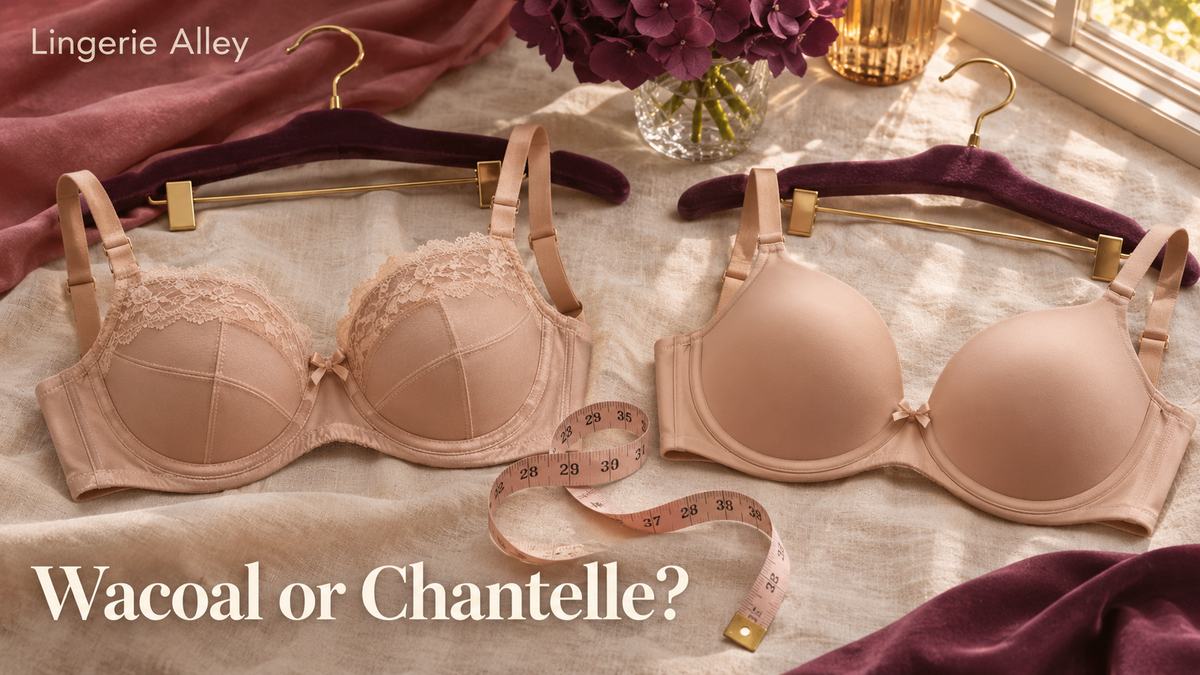
Walk into the intimates floor of almost any US department store and you will find Wacoal and Chantelle hanging a few feet apart, often at similar prices and often on the same sale rack. They look like interchangeable "good bra" brands. They are not. Try a Wacoal and a Chantelle in the same labeled size and the band, the cup depth and even the way the straps sit can feel like two different sizes.
This comparison is about those differences: how each brand tends to build its bestsellers, what that means on your body, and how to get either one for a fair price.
Two Companies, Two Design Habits
Wacoal is a Japanese company incorporated in Kyoto in 1949, and when it arrived in the US in 1985 it leaned on department store fitters to teach shoppers how its bras should fit. That history still shows. Wacoal's core US line leans toward everyday, full-coverage support, with a large share of its bestsellers labeled "full figure" and running into G and H cups. The Basic Beauty full-figure underwire, for example, is listed by Macy's in bands of roughly 32 to 44 and cups up to H.
Chantelle is a French company founded in 1876 that started as a maker of elastic knit, and it is still family owned. Its signature is lace and smooth molded shapes: the company credits its 1972 Défi bra as the first molded seamless bra on the market. Its best-known styles in the US, such as the C Magnifique seamless minimizer and the Norah line, pair fine European lace or smooth stretch knit with a firm, wide band.
Neither habit is better. They solve different problems, and the useful question is which problems you have.
Band Feel: Where Most Shoppers Notice It First
The band does most of a bra's lifting work, so it is the first place to compare.
Wacoal bands
Many Wacoal full-figure styles use a wide, smooth band with a leotard-style back, meaning the band runs straight across rather than dipping in a U. Retailers describe the Retro Chic band as running firm, and the Basic Beauty full-figure closes with three or four hooks depending on size. The feel is broad and even: pressure spreads over a deep strip of fabric rather than one narrow line.
Shopper reviews of a single Wacoal style often split on whether the band runs large or small. Part of that is body shape, since a wide band sits differently on a soft or a firm ribcage, and part is that firmness differs from line to line. Treat the label as a starting point and test the band itself.
Chantelle bands
Chantelle bands tend to be firm with less give in the stretch, built on a European fit tradition where the band is expected to be snug. On support styles like the C Magnifique, the wings are tall and the knit is smooth, so the pressure is firm but flat, with little digging at the edges. The first wear can feel tighter than a US brand in the same label. Give it a full day at home before deciding, because a band that feels snug standing still often feels right once you are sitting, reaching and breathing normally.
The two-finger test
For either brand, fasten the band on the loosest hook, then slide two fingers under the band at your center back. If they slip in easily and you can pull the band more than about two inches away from your body, try a band size down and a cup size up (the sister size). If you cannot get two fingers in at all, go the other way. A new band should fit on the loosest hook so you can tighten it as the elastic relaxes over months of wear.
Cups: Seams vs Smooth Shapes
This is the biggest difference between the two brands and the one most worth testing in person.
Wacoal's seamed and minimizer cups
A large share of Wacoal's full-figure bestsellers use seamed cups, meaning the cup is cut from two or three fabric pieces and sewn together. A seamed cup bends to fit the breast rather than asking the breast to fill a preset shape. The Retro Chic, for instance, uses seamed cups with a sheer lace window at the top for a fuller, rounder shape. Wacoal also sells several minimizer bras, which redistribute volume outward and downward to reduce forward projection under button-front shirts.
Seamed, full-coverage cups tend to suit breasts with more fullness at the bottom than the top, and breasts with softer tissue that benefits from being lifted and held from below. If that sounds like you, the bell-shaped breasts guide explains why bottom-heavy shapes like a seamed cup and a firm underband.
Chantelle's molded and seamless cups
Chantelle is known for smooth, seamless cups, both molded (foam formed in a preset shape) and unlined stretch knit. The C Magnifique is the classic example: a seamless underwire minimizer in a nylon and elastane knit, which Chantelle says reduces projection by up to an inch compared with a T-shirt bra. Smooth cups disappear under fitted knits in a way that seamed lace cups usually do not.
The trade-off: a molded cup has a fixed depth and shape. When it matches you, the result looks seamless under a T-shirt. When it does not, you get a gap at the top edge or a cup that pushes tissue out at the neckline. Stretch-knit seamless cups are more forgiving than foam, which is part of why the C Magnifique has a broad following.
The lean-forward test
In the fitting room, lean forward at the waist, let your breasts fall into the cups, and fasten the band. Stand up and use the scoop and swoop to bring all side tissue into the cup. Then check three things:
- Top edge: Does the cup lie flat against you, or is there a gap you can fit a finger into?
- Wire ends: Does the wire sit behind your breast tissue at the side, or on top of it?
- Center gore: Does the center panel between the cups rest flat on your sternum?
Run it on one Wacoal and one Chantelle, each in whatever size passed the band test, and the brand whose cup shape matches yours is usually obvious within five minutes.
Support and Wear Over Time
Both brands are built to outlast fast-fashion bras. They differ in the kind of support they give.
Wacoal's full-coverage seamed bras hold more of the breast inside the cup, which many people prefer for long workdays, larger cup sizes and tissue that is soft or has changed after pregnancy or with age. The leotard backs and wide wings spread pressure over a broader area, so straps carry less of the load.
Chantelle's smooth bras give a lifted, rounded line with less coverage at the top of the cup. Support comes mostly from the firm band and the cup shape rather than from fabric coverage. That suits firmer tissue and people who want a smooth outline more than maximum coverage.
To get the full life out of either, rotate bras so each rests a day between wears, and skip the dryer: heat breaks down elastane, which both brands rely on.
Pricing and When to Buy
Both brands sit in the mid-premium tier. As of late 2026, regular prices for core underwire styles from either brand mostly fall somewhere around $55 to $100, with lace-heavy or special-edition pieces higher. For what that money buys in construction compared with cheaper and pricier bras, see our $20 vs $60 vs $120 bra comparison.
Sale pricing is where the real value is. Department stores and online retailers discount both brands regularly, and colorways from past seasons often drop far below list price while the core neutral shades stay closer to full price. Check a few retailers before paying list, because the same style in a different color can sit at a very different price. A practical approach:
- Find your size and style in a neutral at full price, in a store where you can try it on.
- Note the style number printed on the tag (Wacoal uses six-digit numbers such as 855192).
- Buy additional colors of that exact style number on sale. Fit should match closely, though it is still worth trying each one on before cutting tags.
When a style fits you well, photograph the inside tag with the style number and size. Brands retire and rename lines, and that photo is the fastest way to ask a fitter for the closest replacement.
Which Brand to Try First
Start with Wacoal if:
- You wear a D cup or larger and want full coverage.
- Your breasts are fuller at the bottom or have softer tissue.
- You want a minimizer for button-front shirts.
- You prefer a wide, broad band that spreads pressure.
Start with Chantelle if:
- You want a smooth outline under fitted knits.
- Your breasts are rounder or firmer and fill a preset cup shape well.
- You like lace that looks like lingerie but still wears daily.
- You are comfortable with a firmer, European-style band.
If you are unsure which shape you have, the breast-shape step in our style quiz narrows it down, and you can compare both brands with others in our brand directory.
Frequently Asked Questions
Do Wacoal and Chantelle use the same size labels?
On US retail sites, both list bras in US-style band and cup sizes, but fit still varies between brands and between styles within each brand. Some Chantelle styles are made in European sizing and converted, so check the size chart on each product page. Expect to try a sister size when you switch brands.
Is a Chantelle minimizer the same as a Wacoal minimizer?
They aim at the same result, less forward projection, but they get there differently. The Chantelle C Magnifique uses a smooth, unlined stretch cup, while Wacoal's minimizers often use seamed cups with more structure. Try both if a minimizer is what you want, because cup shape decides which one sits flatter on you.
Can I buy these brands without trying them on?
Yes, once you know your size in a specific style number. Buying an untested style online is a gamble even within one brand, so order from a retailer with free returns and try it on at home on the loosest hook before removing tags. Order two sizes of the same style, your usual and its sister size, and send back the loser.
Find Your Perfect Fit
Take our 60-second quiz and get personalized lingerie recommendations matched to your body, style, and budget.
Take the Quiz