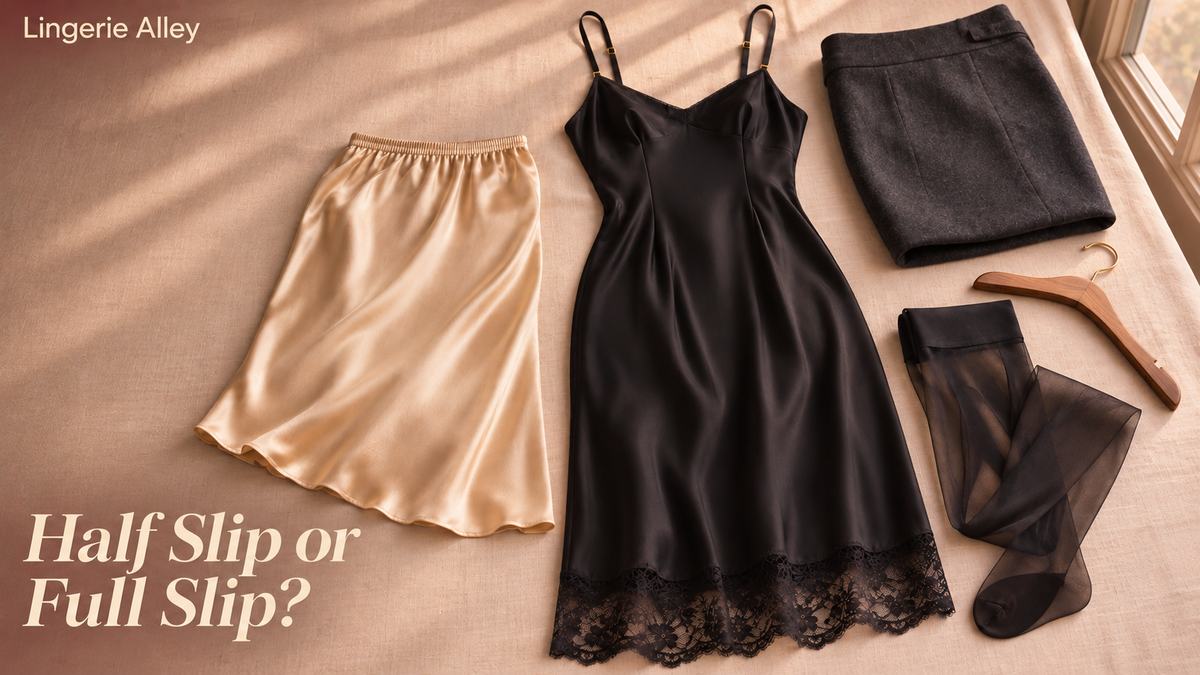
A gray wool skirt over black tights, a dry January office, and by ten in the morning the skirt has crept up and wrapped itself around your knees. You tug it down, it crackles, it climbs again. That is the moment a slip earns its place in a drawer. Slips faded from daily wear, but the problems they solve did not. They just show up less often, so most people meet them without a fix in hand.
So yes, people still wear slips. Not every day, and not under everything. The useful question is which jobs a slip does, and whether you need the half or the full version to do them.
What a Slip Actually Does
A slip is a layer of smooth fabric between your outer garment and your body or tights. That layer does three separate jobs, and it helps to keep them apart because they call for different choices.
Stopping static cling
Cling happens when two fabrics rub, build up an electric charge and then stick to each other. Dry indoor air in winter makes it worse, and synthetic outer fabrics like polyester crepe and some knits are frequent offenders. Tights add another rubbing surface. A slip gives the skirt something slick to slide over instead, so the skirt falls from the waist the way it was cut to fall rather than gripping your legs. It will not make static impossible, but it usually turns a skirt that sticks into one that drapes.
Making an unlined skirt opaque
Thin cotton, linen, voile, chiffon and lightweight knits can be more see-through than they look in the fitting room mirror. Fitting room lighting comes from above. Daylight on a sidewalk comes from behind. A slip blocks the outline of your legs and underwear when light hits the skirt from behind. This is a different job from making your underwear itself invisible. If the issue is panty lines or a bra showing through a white blouse, that is covered in our guide to lingerie under white. A slip deals with the silhouette of your whole body showing through the fabric.
Letting fabric hang
Unlined wool, tweed and textured knits catch on tights and on the grip of shapewear. Some scratchy fabrics also feel unpleasant directly on skin. A slip lets the outer layer float, so a pleated skirt keeps its pleats and a straight skirt stays straight when you walk and sit.
Chafing comes up in conversations about slips, and a long slip can keep a skirt from bunching between the thighs. But slips are not designed to stop thigh rub, because the fabric moves and the hem is above the friction point for most people. For that job, slip shorts and bandelettes do better, and our anti-chafing underwear guide covers them.
Half Slip vs Full Slip: The Real Difference
The names are literal. A half slip starts at the waist and covers the skirt area. A full slip starts at the bust, hangs from shoulder straps and covers bodice and skirt. The choice comes down to where the problem is on the garment.
When a half slip is enough
- Separates: a skirt worn with a top. This is the most common use, and a full slip would only add a bulky layer under your sweater.
- Dresses lined only in the bodice: many summer dresses have a lined top and an unlined skirt. Check the inside seam at the waist; if the lining stops there, a half slip covers the gap.
- Cling below the waist only: if a dress drapes fine over the chest but grabs your legs, you only need slip fabric where the grabbing happens.
A half slip's waistband matters more than its fabric. Look for a soft, plush-backed elastic or a fold-over knit band that is wide enough not to roll. A thin, tight elastic tends to dig in and show as a line under fitted skirts, which defeats the point.
When a full slip is the right call
- Unlined dresses in thin fabric: a cotton shirtdress or a sheer floral needs coverage from top to hem, and a half slip leaves the bodice see-through and a visible edge at the waist.
- Cling across the whole dress: jersey and polyester dresses that stick to your stomach and back, not just your legs.
- Smoothing under knit dresses: a full slip gives a thin knit dress a single smooth surface to lie on, so it does not catch on the edges of your bra, the hem of your underwear or a waistband elsewhere.
Full slips come in two main cuts. A straight cut hangs from the bust and has darts or a seam to shape it. A bias cut is made with the fabric turned on the diagonal, so it stretches slightly and follows the body. Bias-cut slips drape more closely under fitted dresses; straight cuts are easier to fit if your bust and hip measurements fall in different sizes, because there is more ease built in.
Check the straps on a full slip. Adjustable straps with metal or nylon sliders let you line them up with your bra straps so you have one strap per shoulder rather than two side by side.
The camisole option
A camisole plus a half slip covers the same area as a full slip in two pieces. It suits people whose top half and bottom half wear different sizes, and it means you can use the cami alone under a sheer blouse. The tradeoff is a second waistband and a possible ridge where the cami ends, which shows under a fitted dress.
Getting the Length Right
A slip that shows below the hem is the main reason people gave up on them. A few rules prevent it:
- Aim one to two inches shorter than the skirt's hem. Less than an inch and it can peek out when you sit or climb stairs. Much more and the bottom of the skirt is see-through again.
- Match slits. If your skirt has a back vent or side slit, the slip needs a slit in the same place, or the slip will show through the opening every time you take a step. Many slips have a side slit you can turn to the back.
- Watch lace hems. Lace trim adds a slightly thicker band at the bottom that can show as a ridge under thin, fitted skirts. A plain or narrow-hemmed edge disappears more easily.
- Test sitting down. Skirts ride up when you sit; slips usually ride up less. If you can see the slip when seated, it is too long for that skirt.
Owning two lengths, a knee length and a midi, covers most skirts. For an unlined maxi, a long slip in a matching color does the same job.
Fabric and Color
Choosing the fabric
- Nylon tricot: the classic. Smooth, thin, cheap and washes well. It is the most common slip fabric for a reason.
- Polyester satin or charmeuse: slick and widely available, with a slight sheen that can show through very thin skirts under bright light.
- Silk: breathes better than synthetics and feels cooler in warm weather. More delicate, and most need hand washing.
- Cotton batiste: a fine, lightweight woven cotton. It is breathable and comfortable in heat, but less slippery, so it does less for cling.
- Cupro and rayon: used for linings in many dresses, smooth and breathable, and a good middle ground if you find nylon warm.
If static is your main problem, a slippery fabric does the most work. If it is mostly coverage in hot weather, a breathable one is more comfortable.
Choosing the color
Under a light-colored or sheer garment, pick a slip close to your skin tone rather than white. A white slip under a white dress outlines itself; a skin-tone slip blends in. Under dark garments, match the outer color, usually black or navy. If you only buy one, a skin-tone one covers more of your wardrobe.
Quick Tests Before You Leave the House
- The window test: stand with a window or lamp behind you and check in a mirror or phone camera. If you can see the outline of your legs, add a slip.
- The crackle test: run your hand down the skirt. If it clings, or you hear crackling, a slip will help.
- The stairs test: walk up a few steps. If the skirt grabs your tights or rides up, try a slip.
- The sit test: sit down and check the hem from the front and side.
Where to Start
If you own no slips at all, start with one skin-tone half slip in nylon tricot, knee length, with a side slit you can turn to the back. Wear it under the skirt that gives you the most trouble for a week. Within a few days you will know whether you also need a full slip, and which length to add next.
Frequently Asked Questions
Is it old-fashioned to wear a slip?
It depends on whether anyone can see it. A slip that stays under the garment is invisible, so no one can tell. The slip dress worn on its own as an outer garment is a separate fashion item, and that one comes and goes with trends.
Can I wear a slip under pants?
A skirt slip will not work under trousers, but the same idea exists in leg form. Pettipants, sometimes called culotte slips, are loose, slick shorts or long legs worn under wide-leg trousers and culottes. Under fitted pants, smooth thin leggings do a similar job against cling.
Do I still need a slip if my dress is lined?
Usually not. The lining is already doing the slip's job. The exceptions are a lined dress that still clings in very dry weather, or a lining thin enough to see through. Wedding gowns usually have their own lining or crinoline, and our guide to what to wear under your wedding dress covers what goes beneath them.
How do I keep a slip from riding up?
A slip that rides up is often a size too small at the hip or a fabric that grips your tights. Try the next size up, or switch to a slicker fabric such as nylon tricot. Check the slit too: a slip with no slit gets dragged upward by every long stride.
Find Your Perfect Fit
Take our 60-second quiz and get personalized lingerie recommendations matched to your body, style, and budget.
Take the Quiz