You know the bra. The wire sits snugly behind the breast tissue at the side, the center gore lies flat against your sternum, the band is level, and yet there is a firm line across the top of each breast where the cup edge presses in. Under a T-shirt it reads as a ridge, sometimes as the "four breasts" look. A fitter would call the size right. Your mirror says otherwise.
That gap between a correct size and a bad fit is usually about where the tissue sits. Full-on-top breasts carry more of their volume above the nipple than below it, and the default cup, especially the molded T-shirt cup, is shaped for the opposite.
What Full-on-Top Actually Means
Breast shape is mostly about two things: where the tissue starts on the chest (the root) and how the volume is spread across it. Full-on-top describes the spread. The upper pole, the part between the top of the root and the nipple, is as full as or fuller than the lower pole. From the side, the slope from collarbone to nipple looks more like a rounded hill than a gentle ramp, and the lower curve can be fairly short.
A few things often go along with it, though none is required:
- The nipple sits at or slightly below the midpoint of the breast, rather than above it.
- The breast feels firm or dense at the top.
- Balconettes and half-cups that your friends call "barely there" feel like they cover plenty.
It is not the same as projection, and it is not the same as being between sizes. Shape and size can both be off, but they need separate fixes.
If you are not sure which shape you have, the breast-shape step in our style quiz walks through it with diagrams before it suggests anything.
Is It Shape or Is It Size?
Upper spillage gets diagnosed as "go up a cup" more often than it should. Sometimes that is correct. Here is how to tell, standing in front of a mirror with your usual bra on, after you have leaned forward and scooped all the tissue from your side and underarm into the cup.
Signs the cup is too small
- The wire sits on breast tissue at the side or under the arm instead of behind it.
- The center gore lifts away from your sternum, even a few millimeters.
- Tissue spills at the side as well as the top.
If any of these show up, the cup is too small. Our guide to the eight signs your bra doesn't fit goes through each of these and the size change that answers it.
Signs it is the shape of the cup
- The wire is in the right place and the gore tacks.
- The lower half of the cup is full but not tight, and maybe even has a little room at the very bottom.
- The cut-in happens only along the top edge, as a straight line across the breast.
- Going up a cup makes the bottom wrinkle or the wires reach into your armpits, while the top edge still presses in.
That last one is the giveaway. If the bigger size is too big everywhere except the top, the cup's shape is wrong for you and no size of that bra will fix it.
Why the Top Edge Cuts In
A cup's top edge is a line held taut between strap and gore. On a breast with most of its volume below the nipple, that line lies flat against the chest. On a full-on-top breast, it crosses the fullest part. Something has to give, and if the edge is rigid, it is the tissue that gives.
Three kinds of top edge cause most of the trouble:
- Molded foam edges. A spacer or foam T-shirt cup is formed in a mold with a fixed shape. Its top edge has no stretch at all, and the mold usually assumes more lower fullness than upper. It is the most common culprit.
- Full-coverage cups with a firm top band. Many full cups finish the top with a non-stretch binding or a rigid lace trim. The coverage is high, so the edge lands right across the fullest area.
- Push-up padding. Push-ups put padding in the lower and outer cup to move tissue up and in. If your tissue is already up, the padding has nowhere useful to send it except over the edge.
Strap tension makes it worse. Tightening straps pulls the top edge of the cup upward and inward, which tightens that line across your breast. If you have been cranking your straps to "hold everything in," try loosening them a notch and see whether the ridge softens. The band should be doing most of the support work anyway.
The Cuts That Fix It
The fix in every case is the same idea: give the top edge somewhere to go, either by lowering it, opening it or letting it stretch.
Stretch-lace top cups
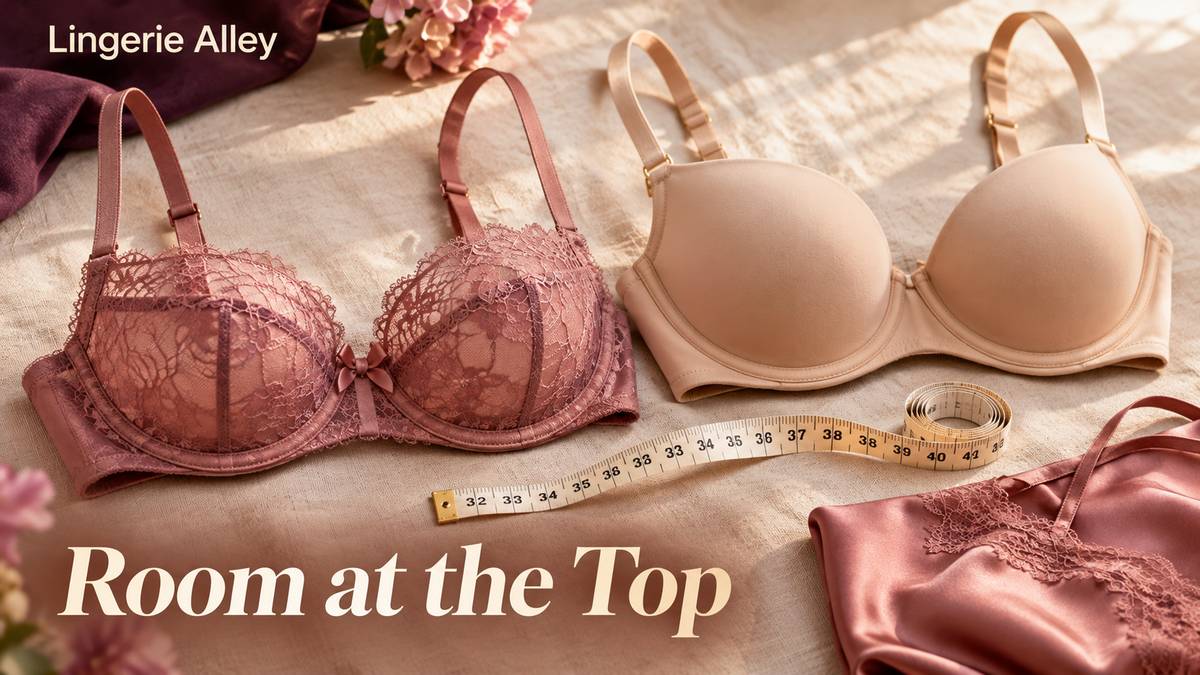
This is the most reliable fix. The lower cup is firm seamed fabric that lifts and shapes, and the upper cup is a separate panel of stretch lace or tulle that expands to whatever volume you have without leaving a line.
Look for a horizontal seam with visibly softer fabric above it, and stretch the top edge gently. If it gives and springs back, it is the right kind.
Open-top balconettes
A balconette with a low, wide neckline and a top edge that runs nearly horizontal from strap to gore leaves the upper pole uncovered instead of compressing it. Three-part seamed balconettes, with a vertical seam splitting the lower cup and a horizontal seam above it, shape the breast forward and up without pressing on the top.
The thing to check is where the edge falls. On a good balconette for you, the top edge lands a little above the nipple, low enough that the fullest part of your upper breast sits above it rather than under it. If the neckline is closer to your collarbone than that, it is functioning more like a full cup.
Plunges with a stretch upper
A plunge has a low center gore and an angled top edge that drops toward the middle. That angle helps because it covers less of the inner upper breast, where full-on-top tissue often presses. Plunges work best for you when the upper cup is unlined or stretch rather than molded foam. A molded plunge has the same rigid edge problem, just at an angle.
Unlined seamed cups
Even without a stretch panel, a seamed unlined cup has more give than foam. If you prefer full coverage, a seamed full cup with a soft upper section usually fits far better than a molded one in the same size.
Styles That Tend to Struggle
These are not off-limits, but they are where the cut-in usually shows up first:
- Molded T-shirt bras, especially spacer foam with a high neckline.
- Push-up and "add a cup" bras with bottom-loaded padding.
- Full-cup minimizers with a firm top edge.
- Sports bras with a high, tight neckline and encapsulated molded cups.
If you love the smooth look of a T-shirt bra, try one with a molded lower cup and a soft mesh upper cup. For the opposite problem, an empty top cup, see our guide to bras for shallow breasts.
Four Tests to Run in the Fitting Room
Bring a thin, fitted T-shirt in a light color. Then, for every bra:
- The scoop and settle. Lean forward, scoop each breast into the cup from the side, stand up, and let everything settle for a minute. Judge only after this.
- The thumb run. Slide your thumb along the top edge from strap to gore. The edge should lie flush, so your thumb glides along it without lifting it or sinking into tissue. If your thumb has to push down to get under it, that edge will show through a shirt.
- The T-shirt check. Put the shirt on and look at yourself in profile, then from three-quarters. A clean slope from collarbone to bust means the top edge is working. A visible step or ridge means it is not.
- The reach and twist. Raise both arms, reach across your body, and twist at the waist. Tissue moves up when you lift, so a cup that is barely fine standing still will often start cutting in here.
Then wear it at home for a full afternoon before cutting the tags.
Frequently Asked Questions
Can full-on-top breasts change over time?
Yes. Breast tissue changes with weight changes, the menstrual cycle, pregnancy, breastfeeding and age, and the distribution can shift as well as the size. A bra that fit cleanly a few years ago may start leaving a line now without your size changing much, so it is worth rechecking shape when your bras start to feel different.
Do wireless bras work for full-on-top breasts?
They often do, because most wireless bras are made of stretch fabrics that do not create a rigid top edge. The trade-off is lift and separation, which wireless bras give less of. Look for a wireless style with a seamed or sling-style lower cup and a stretch upper section for the closest match to an underwire balconette.
Should I wear a balconette or a plunge for upper fullness?
Both can work, and the choice usually comes down to your breast spacing and necklines; our balconette vs plunge comparison goes through that decision. For upper fullness, what matters more than the cut is that the upper cup is open, low or stretch rather than molded.
Is upper spillage a sign of a medical issue?
Upper spillage from a bra is a fit issue, not a medical one. That said, any new lump, persistent swelling, skin dimpling or other change you notice in your breasts is something major health organizations such as the American Cancer Society recommend reporting to a doctor promptly, whatever bra you wear.
Before Your Next Order
Next time you shop, start by searching a brand's site for words like "stretch lace," "balconette" or "unlined" instead of filtering by size alone, then use the thumb run on the first few that arrive. Once you find one cup construction that leaves no line, note the brand and the style family, since that same cup pattern often carries across a whole line.
Find Your Perfect Fit
Take our 60-second quiz and get personalized lingerie recommendations matched to your body, style, and budget.
Take the Quiz