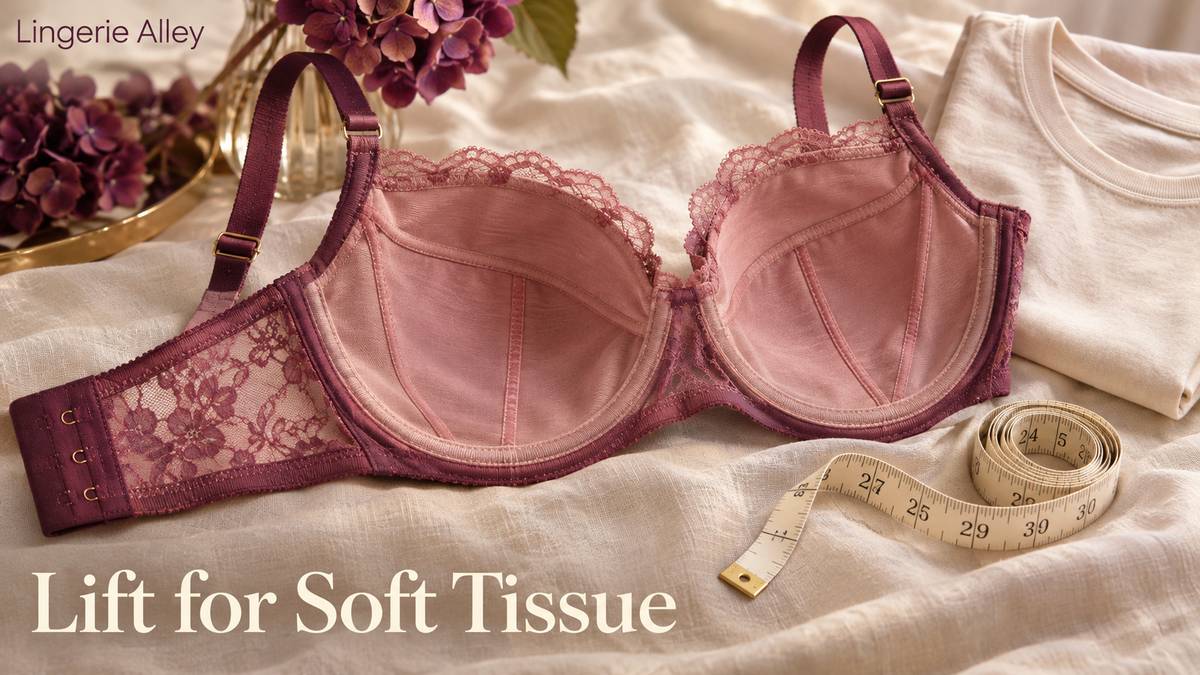
Put on your most-worn bra, bend forward at the waist, and stay there a few seconds. If tissue rolls out over the top edge, or drops out of the bottom of the cup and sits on the wire when you stand up, the cup is not holding your breast. It is only resting against it. That is the everyday experience of relaxed breasts in the wrong construction, and it is fixable with a different kind of cup, not a different attitude.
What "Relaxed" Actually Describes
Relaxed is a tissue description, not an age. It means breast tissue that is soft and moves easily, with the fullness sitting lower on the chest and the nipple often pointing slightly downward. Without a bra, the breast tends to settle down and spread out to the sides rather than holding a fixed shape.
Some people have soft tissue from their teens; others notice it after pregnancy, breastfeeding, a weight change or simply the years. The Over-35 Lingerie Guide covers the age side of that story. This article sticks to construction, because the bra that works for soft tissue at 24 is built the same way as the one that works at 54.
You can be relaxed and wide-set, or relaxed and bell-shaped. What sets relaxed apart is behavior: the tissue takes the shape of whatever contains it, and that one fact explains why so many popular bras disappoint.
Why Push-Ups and Unlined Cups Both Fail
These two sit at opposite ends of the bra wall, and soft tissue defeats both for the same reason: neither gives it a shape to settle into.
Push-ups push, but soft tissue does not stay pushed
A push-up places an angled pad in the lower and outer part of the cup. On firm tissue, that pad moves the breast up and toward the center, and the breast holds the new position. Soft tissue does something different. The pad takes up the room in the bottom of the cup, so the tissue it displaces has nowhere to go but over the top edge. Push-up cups are also usually cut low, so the top edge sits right where that displaced tissue lands. The result is a ridge across the neckline, visible through a T-shirt, and a bra that looks lifted for the first ten minutes and spilled by lunch.
Underneath, the pad keeps the breast from reaching the bottom of the cup, so the wire often ends up sitting on tissue instead of the ribcage, and that is where a lot of so-called underwire pain starts.
Unlined stretch cups give way
A seamless cup made of one layer of stretch lace or mesh has no shape of its own. Firm tissue does not mind, because it shapes the cup. Soft tissue needs the cup to shape it, and a single stretch layer has little to offer. The fabric gives under the weight, and the breast settles to the bottom of the cup and out toward the armpit. Comfortable, lovely on a hanger, no lift.
And smooth molded foam often wrinkles
Molded T-shirt cups hold a preset round shape, usually fuller at the top than relaxed tissue is. The bottom fills, the top does not, and the foam dents inward or stands away from the chest. A molded cup with a shallow top and deep bottom can work, but it is the hardest style to match.
The Construction That Lifts Without Displacing
Soft tissue needs a cup that gathers the breast from the sides and bottom, holds it forward, and lets the top edge follow whatever fullness is actually there.
Seamed cups, ideally three-part
Every seam is a built-in curve, and that matters more for soft tissue than for any other type. In a firm breast the shape lives in the tissue. In a relaxed breast it has to live in the cup. A three-part cup, with two lower pieces joined by a vertical or slanted seam, holds a forward, rounded form on its own, so the breast is projected out from the chest rather than squashed up. Two-part cups with a single horizontal seam, common in balconettes, also work for many people, as long as the lower piece is firm.
An apex that sits where your fullness is
The apex is where the seams meet, the most projected point of the cup. On relaxed tissue the fullest part of the breast often sits lower than many patterns assume. If the apex sits above your nipple, the cup holds the top of the breast and leaves the bottom slumped inside it. In a side mirror view the two should line up. When they do not, try a different style rather than a different size, because apex height is part of the pattern.
A side support panel
A side support panel, or side sling, is an extra layer of firm fabric inside the outer edge of the cup that steers tissue forward instead of letting it drift toward the armpit. Soft tissue spreads sideways the moment nothing stops it, so this is often the single most useful feature on the label.
Rigid lining low, stretch lace high
The best cups for soft tissue are firm where the weight sits and flexible where it does not: a non-stretch lining such as rigid sheer mesh in the lower cup, and stretch lace along the top edge. That stretch edge lies flat whatever your upper fullness, so the cup neither gaps nor cuts in. Pull the lower cup sideways in your hands; if it barely gives, that is a good sign.
A firm band, and straps you stop tightening
Fitters say most support should come from the band, and soft tissue tests that rule hard. A narrow, soft band lets the cups drop forward, and the common reaction is to shorten the straps to fake some lift. That hikes the back of the band up, tips the cups further down at the front and leaves grooves in your shoulders. Loosen them until they just stay put, and judge the bra on the band alone. If your breasts are also heavy, the bell-shaped breasts guide goes deeper on bands and straps that carry weight.
Wire shape and gore height
Wires that reach a little higher at the side help collect tissue that spreads outward. A gore of moderate height that sits flat on the sternum keeps each breast in its own cup; a very low plunge gore often lets soft tissue slide toward the middle.
Styles Worth Trying First
Three seamed styles make the most reliable starting points:
- Three-part full cup. The most hold and coverage, and the everyday workhorse.
- Seamed balconette. A lower, wider neckline with strong forward lift; the straps usually sit wider apart, which suits square necklines.
- Longline seamed bra. A taller band that spreads the load, useful if a standard band rolls or shifts.
On wire-free days, choose a wireless bra that still has seamed cups and a side panel. It lifts less than an underwire but holds soft tissue far better than a seamless pullover. Our style quiz has a breast-shape step that factors relaxed tissue into its bra suggestions.
Five Fitting Tests for Soft Tissue
Soft tissue settles wherever it lands, so how you put the bra on matters more here than for any other shape. Use the scoop and swoop method first, then run these checks.
- The wire check. Run a finger along the wire under each breast. You should feel ribcage, not breast tissue, all the way along. Soft tissue can fold under a wire without hurting at first.
- The re-scoop check. Walk around for ten minutes, then scoop again. If a handful of tissue comes back from under your arm, the side support is not doing its job, even if the bra felt fine at first.
- The sit-down check. Sit and slouch a little, the way you do at a desk, so the tissue settles. The top edge should still lie flat, and nothing should bulge over the wire at the bottom.
- The arm raise. Lift both arms above your head. The band should stay level and the wires should not ride up off the ribcage.
- The T-shirt profile. Put on a thin, close-fitting top and look from the side. The shape should be smooth and forward, with the fullest point roughly halfway between shoulder and elbow and no shelf at the neckline.
If the top edge cuts in with a ridge, try the next cup size up or a cup with a higher top edge. If it gaps, look for a stretch lace upper cup rather than going down a cup size.
Frequently Asked Questions
Is relaxed the same as saggy?
Relaxed is the neutral term fitters use for soft tissue that sits lower and moves easily. It describes behavior, not how breasts should look, and plenty of people with relaxed tissue are in their twenties.
Can relaxed breasts wear a plunge bra?
Yes, if it has seamed cups and a firm lower cup. A molded push-up plunge tends to push soft tissue over the top, while a seamed plunge with a side panel gathers it toward the center.
Do I need a bigger cup size if my breasts are relaxed?
Not automatically. Soft tissue often looks smaller in a bra that is not holding it, because it spreads to the sides. Once a side panel brings that tissue forward, many people find the cup they thought was too big now fits.
Will wearing the right bra make my breasts firmer?
A bra holds tissue in place while you wear it, but it does not change the tissue itself. Choose a bra for comfort and the shape you like under clothes, not as a treatment.
Once You Find One, Shop by Style Name
When a seamed bra finally passes every test, write down the brand's style name or number, not just the size. Brands often reuse a cup pattern across colors and seasonal prints, while a different style from the same brand, in the same size, can have a different apex height and side panel. When you shop for a second bra, search for "three-part", "seamed" or "side support" in product descriptions first, and treat a lookalike in your size as a new fitting, not a repeat purchase.
Find Your Perfect Fit
Take our 60-second quiz and get personalized lingerie recommendations matched to your body, style, and budget.
Take the Quiz