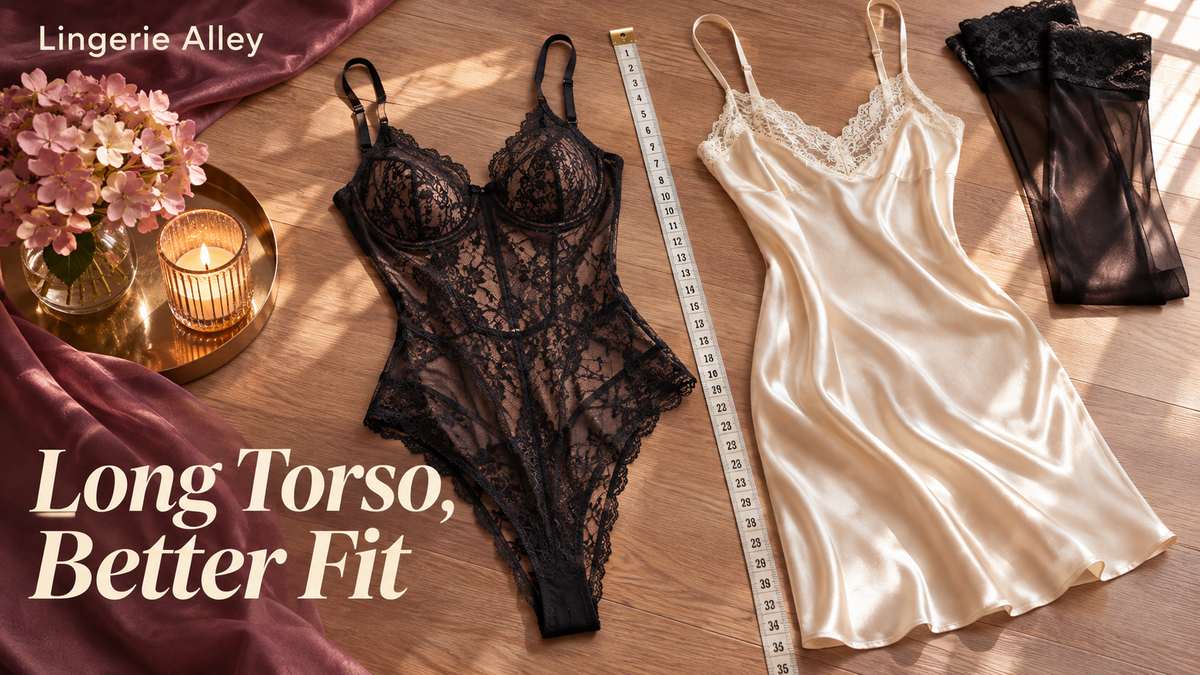
Here is the test that tells you whether a bodysuit is too short: fasten the snaps, then sit down and reach for something on the floor. If the straps saw into your shoulders and the gusset climbs, the garment is shorter than you are from shoulder to crotch, and no amount of strap adjusting will fix it. That one movement explains most of the trouble tall women have with one-pieces.
This guide is for women around 5'9" and up, and for anyone with a long torso at any height. It covers the pieces where length decides everything: bodysuits, teddies, slips, high-rise briefs and stockings. Bras get a short section, because height affects them less than you might expect.
Height Is Not the Measurement That Matters
Two women can both be 5'11" and need completely different bodysuits. One has long legs and an average torso; the other has an average inseam and a long trunk. Size charts list bust, waist and hips, and assume a torso length that matches. When your torso is longer than the pattern assumes, the garment has to stretch vertically, and stretch fabric under vertical tension does three things: it narrows, it pulls the neckline down, and it drags the crotch up.
How to measure your torso length
The number you want is the torso loop, sometimes called torso girth or trunk length. Swimwear brands list it more often than lingerie brands do.
- Stand straight in a thin top or your bra.
- Put the end of a soft tape measure on top of one shoulder, halfway between your neck and the edge of the shoulder.
- Run it down over the front of your body, through the crotch and back up your spine to the same spot.
- Keep the tape snug but not tight, and read the number where it meets the start.
If a product page lists a torso measurement, compare yours to it directly. If not, measure the same loop on a bodysuit that fits you, laid flat and unstretched, then compare garments by measurement instead of by size label.
Long legs versus long torso
If your torso loop is close to average but you are tall, most of the trouble you have will be with rise and hem length rather than one-pieces. If your torso loop is long, one-pieces are where you need to be choosy.
Bodysuits That Actually Reach
A bodysuit is the garment most likely to fail a long torso, because it is fitted at the shoulders and anchored at the crotch with nothing in between to give.
What to look for in the construction
- Fabric with real vertical stretch. Check the fiber content. A knit with a meaningful amount of elastane stretches in both directions; a rigid lace front with stretch only at the sides will not lengthen at all.
- Adjustable straps with a long slider range. Straps that adjust from both front and back give more total length than a single slider at the back.
- A gusset with more than one row of snaps. A few bodysuits have two or three rows of snaps, which lets you choose a lower closing point. It adds an inch or so, which matters on a long torso.
- A scoop or plunge neckline. A neckline that sits lower to begin with has less distance to be pulled down before it looks wrong.
- Thong or cheeky back. This is counterintuitive, but a thong-back bodysuit often fits a long torso better than a full-seat one, because there is less fabric being pulled tight across the seat.
Sizing up, and when it fails
The common advice is to size up. In very stretchy fabrics it can work, but a size up adds width at the bust and hips as well as length, so the cups and underband may sit too low and too loose. That means the piece was cut for a different body, not that yours is wrong.
Where a brand offers a tall or long-torso version of a bodysuit, that is almost always the better buy than sizing up, because the extra length is added only between bust and crotch. Some activewear and basics brands do this; lingerie brands do it less often. Our brand directory is a good place to start comparing who cuts what.
If you wear bodysuits mainly under jeans or a skirt, our guide to bodysuits as everyday wear covers the styling side.
Teddies and One-Piece Bedroom Lingerie
Teddies have the same problem as bodysuits, with less help from the fabric. Many are lace or mesh with a fixed length, and their crotch closure is often a single row of snaps or hooks.
Checking a teddy before the tags come off
Do the floor-reach test from the start of this article, wearing your own underwear underneath and with the hygiene liner in place. Then stand and lift both arms overhead. A teddy that fits a long torso stays where it is when you reach up; one that is too short lifts at the crotch and pulls the cups down.
When a teddy will not work, switch styles
If one-piece lingerie keeps falling short, the two-piece versions of the same look are a good alternative. A longline bra with a matching high-waist brief gives you a similar line with no vertical tension at all. A babydoll or chemise hangs from the shoulders and is never anchored below, so torso length only affects where the hem lands.
Slips, Chemises and Hem Length
A slip or chemise that hits mid-thigh on a 5'5" model will land several inches higher on you. That can be a lovely look for the bedroom and a problem under a dress.
Reading the length on a product page
Look for the garment length measurement, usually taken from the top of the strap or the highest point of the bodice to the hem. Hold a tape measure from your own shoulder down to where you want the hem, and compare. Do not rely on the model photo.
Cut makes a difference
- Bias-cut satin is cut diagonally across the grain, so it has a little give and molds to the body instead of pulling straight down, which makes it more forgiving on a long frame.
- Straight-cut chemises in stretch jersey hold their length but cling more.
- Adjustable straps let you lower the whole garment, but every inch you add at the strap moves the neckline down by an inch too.
For a slip worn under a dress, look for one sold by length rather than by size alone, or choose a half slip, which is anchored at the waist and has nothing to do with your torso at all.
High-Rise Briefs and Waistbands
Tall women with long torsos often notice that high-rise briefs sit a little lower than the product photo suggests, usually somewhere between the navel and the hip bone rather than at the natural waist. This is the mirror of what petite women describe, where high-rise reaches almost to the ribs (our petite lingerie guide covers that side).
If you want a brief that actually sits at your waist, look for the front rise measurement and compare it to your own: measure from the center of your crotch to the point on your waist where you want the band. Styles labeled "super high-rise" or "ultra high-waist" are sometimes simply a regular high-rise for a long torso. Leg openings matter too: a high-cut leg on a long body sits higher on the hip, which some women love and some do not.
Stockings and Garters on Long Legs
Thigh-highs are made to a set length per size, so on long legs the welt (the lace or silicone top band) can land mid-thigh. Hosiery charts usually combine height and weight; follow the height column first. Garter straps need a slider with enough range to reach that welt, so measure from belt to stocking top before you buy.
Bras: What Height Changes and What It Does Not
Your bra size is about your ribcage and breast volume, not your height. A tall woman does not automatically need a different bra. What height can change is strap length: on a long torso, the distance from shoulder to the top of the cup may be longer, and you may wear the straps at or near their longest setting. If that leaves no room to tighten as the elastic relaxes, a racerback or J-hook converter will not help, because it shortens the strap. Instead look for bras with longer strap adjusters, or have a tailor add a few inches of strap.
Breast shape matters far more than height for cup fit. If you have not worked out yours yet, the quiz includes a breast-shape step and matches bra styles to it.
Frequently Asked Questions
What counts as a long torso?
There is no official cut-off. A practical sign is that bodysuits and one-piece swimsuits in your usual size feel tight vertically while fitting well around the bust and hips. Measuring your torso loop and comparing it with brand size charts that list it is the most reliable check.
Can a tailor lengthen a bodysuit?
Usually only a little. A tailor can sometimes add a fabric extension at the gusset or lengthen the straps with matching elastic, but adding length through the body is rarely practical. Buying a tall cut or switching to a two-piece set is normally easier and cheaper.
Are thong bodysuits more comfortable on a long torso?
Often, yes, because there is less fabric across the seat being pulled tight. They still need enough torso length to avoid the gusset digging in, so do the sitting test before you remove the tags.
Do shapewear bodysuits follow the same rules?
Even more so. Shapewear is firmer and has less spare stretch than a lace or jersey bodysuit, so a short torso length shows up quickly as straps digging in and a gusset that will not stay put. Do the sit-and-reach test before you commit, and treat the torso loop on the size chart as seriously as the waist and hip numbers.
One last shortcut when you shop online: look for the model's height and size in the product details. A 5'10" model wearing a size small in a bodysuit that still sits flat at the shoulders tells you more about its length than any size chart, and a page that shows only a 5'7" model is a cue to check the return policy before you order.
Find Your Perfect Fit
Take our 60-second quiz and get personalized lingerie recommendations matched to your body, style, and budget.
Take the Quiz