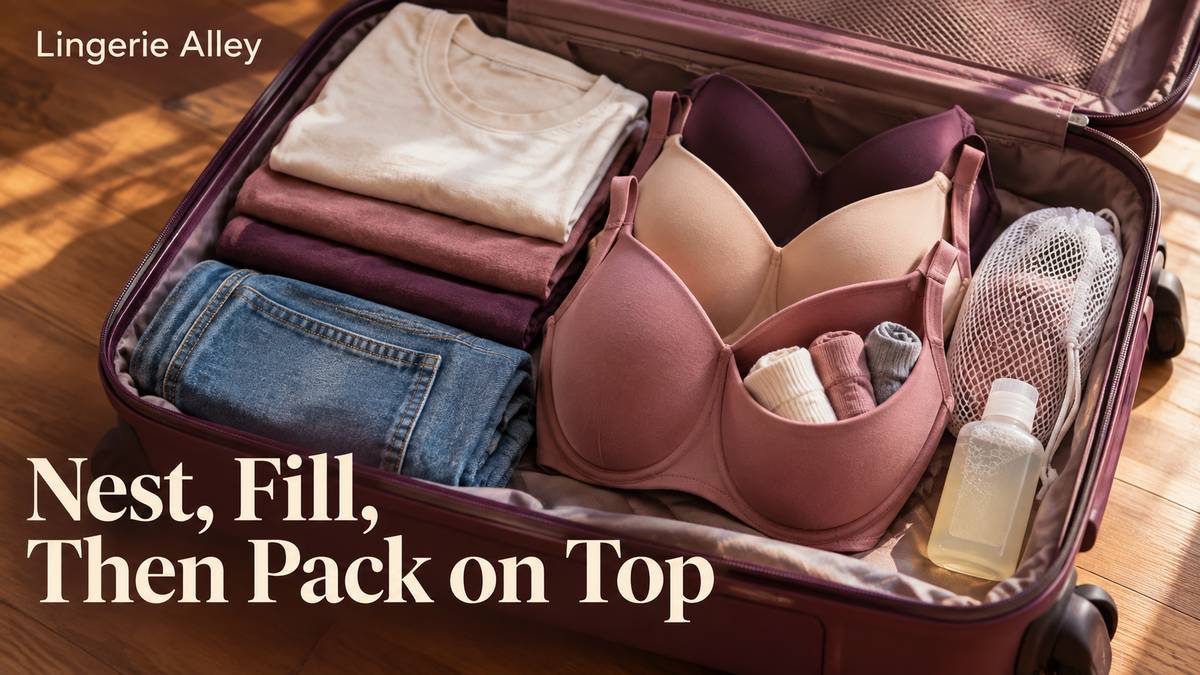
The dent usually happens before the bag leaves the bedroom. You zip a suitcase shut, the lid presses a pair of jeans straight down onto the top of a molded cup, and the foam takes a crease that sits there for the rest of the trip. On an older bra, it may never quite leave.
The fix is not a special gadget. It is understanding what a molded cup is made of, then packing so that pressure spreads across the whole curve instead of landing on one point.
What Actually Damages a Molded Cup
Most t-shirt bras, push-ups and contour bras use cups made from foam that has been heat-set into a dome. The foam is covered in a smooth fabric layer, and the dome holds its shape because the material was formed that way. Two things undo that shape.
The first is folding one cup inside the other. That forces the outer curve of the cup to invert, and the fold line becomes a crease. Do it once and the bra usually recovers. Do it every time you travel and the crease starts to show under a fitted top as a faint line or a dimple near the apex.
The second is point pressure. A shoe heel, the corner of a toiletry bag, or a tightly compressed packing cube pushing on the center of a cup for eight hours can leave a dent. Weight spread evenly across the whole cup is far less of a problem than one hard edge.
Underwire adds its own concern. A wire is designed to flex slightly along its length, not to be bent in half across the middle. Folding a wired bra widthwise, so the two wires bow toward each other, stresses the wire and the channeling that holds it. Over many trips that is one route to a wire working its way out of its casing.
Soft cups are different. Unlined lace, seamed cut-and-sew cups, bralettes and most sports bras have no foam shape to protect, so they can be folded or rolled freely.
The Nesting Method, Step by Step
This is the technique for molded and padded bras. It takes about a minute and works in any bag.
1. Close every hook
Fasten the hook-and-eye closure on each bra before it goes anywhere. Open hooks catch on lace, mesh and knit clothing, and in a moving suitcase they snag far more than they would in a drawer.
2. Stack the cups facing the same way
Lay the first bra cups-up on a flat surface. Place the second bra on top so its cups sit inside the first bra's cups, curve into curve. Add a third and fourth the same way. You are building a stack of matching domes, not folding anything.
Line them up by shape if you can. A deep plunge with a low center gore nests poorly inside a full-coverage cup with a tall gore, so put bras with similar cup depth together. If one bra is clearly bigger in the cup, it goes on the bottom.
3. Fill the top cups
The top bra's cups are the hollow, vulnerable part of the stack. Fill them with something soft that you are packing anyway: rolled socks, two or three rolled pairs of underwear, a folded tank top, a swimsuit bottom. The filling acts like a mold, so if something presses down, it presses on fabric that pushes back.
4. Tuck the straps and band inside
Fold the band wings in toward the cups and lay the straps across the filling. Nothing should hang loose. Loose straps get wrapped around other items and pulled when you unpack in a hurry.
5. Optional: a case or a cup-shaped shell
A semi-rigid bra case holds the nested stack in shape and is useful if you travel often with several molded bras. Without one, a small packing cube left loose (not compressed) does most of the same job, and so does a cloth shoe bag.
Where the Stack Goes in Your Bag
Placement matters as much as nesting.
Hard-shell suitcase
Put the stack near the top corner of the lid side or in the corner of the main compartment, cups facing up toward the lid. Pack heavier things, like shoes and toiletries, along the wheel end, which is the bottom when the case stands upright. When the suitcase rolls, gravity pulls those items down and away from the bras.
Fill the space around the stack with soft items so it cannot slide. A stack that travels from one end of the case to the other gets knocked into everything on the way.
Soft-sided bag or duffel
Soft bags flex, so the risk is a squeeze from the sides when the bag gets wedged into an overhead bin. Put the stack in the middle of the bag, surrounded by folded clothes on every side, rather than against an outer wall.
Carry-on and personal item
If you only have a carry-on, a backpack-style personal item is often the safest spot for the bra stack, since it rides at your feet instead of under other bags. A soft-sided carry-on in a full overhead bin gets squeezed by whatever the next passenger shoves in beside it.
On security: TSA's 3-1-1 liquids rule limits carry-on liquids to containers of 3.4 ounces (100 ml) or less, all fitting in one quart-size bag. That includes liquid detergent for washing bras on the road. Sheet detergent or a small solid bar avoids the question.
What not to do with compression cubes
Compression packing cubes are good for t-shirts and leggings. They are a bad home for molded bras, because zipping the compression panel flattens the cups. If you love your cubes, use a non-compressing one for bras and compress everything else.
Packing Bras That Are Not Molded
Different construction, different technique.
- Unlined lace and seamed cups: Fold in half at the center gore, one cup laid on top of the other, then fold the band in. If there is a wire, fold so the wires lie flat against each other, not bent across.
- Bralettes: Fold or roll. They can go anywhere, including around the edges of the bag.
- Sports bras: Roll tightly. Most are compression knit with no structured cup, and rolling keeps them compact. Molded-cup sports bras go in the nested stack instead.
- Strapless and longline bras: These usually have a wider band with boning or silicone grip. Lay them flat along the side of the case so the boning is not bent, and keep the silicone strip away from lace, which it can grip and pull.
Quick-Dry Picks for Long Trips
On trips longer than a week, washing in a sink beats packing more bras. The bras that make this easy share a few traits.
What dries fast
Thin nylon or polyester microfiber, power mesh and lightweight lace dry fastest, often overnight in a ventilated room. Thick foam cups hold water in the foam layer and can take a full day or more, especially in humid weather. Cotton-lined cups dry slowly too.
A spacer foam cup (the kind with an open, breathable texture visible inside) usually dries faster than dense foam of the same thickness.
The towel roll
After washing, gently press out the water. Do not wring a molded cup. Lay the bra flat on a dry bath towel, roll the towel up firmly, and press down along the roll. Unroll, reshape the cups with your hands, and hang it by the center gore or lay it flat. This pulls out much of the water before the bra ever goes on a hanger.
Keep wet bras away from hotel radiators and heaters. Direct heat is hard on elastic, and the band's elastic is what holds up most of the support.
How many to pack
For a week or more with sink washing, three bras usually covers it: one on, one drying, one spare. Two of those can be quick-dry styles, and the third can be the molded t-shirt bra you need under fitted tops. If you want a wider framework for which pieces earn a place, the capsule lingerie wardrobe works well as a packing list too. For a honeymoon specifically, the honeymoon packing guide covers which special pieces to bring.
Unpacking and the Trip Home
When you arrive, take the stack out first and hang or lay the bras flat. Any slight dent in a foam cup often relaxes after a few hours in the open air. Pressing gently from the inside of the cup, the way you would smooth a dent in a hat, helps it along.
For the return trip, keep worn bras in a separate mesh laundry bag or a cloth bag. That way they can go straight into the wash when you get home, and the mesh bag doubles as the wash bag. Once home, store them properly so the cups recover between trips.
Frequently Asked Questions
Can I put an underwire bra in my carry-on?
Yes. Bras are clothing, and underwire bras go in carry-on bags like any other garment. The only packing rule that touches your bra kit at security is the liquids limit, which applies to the detergent, not the bras.
Is it better to roll or fold bras when packing?
It depends on the cup. Roll sports bras and bralettes without molded cups, fold unlined bras at the center gore, and never roll or fold a molded cup. Molded bras should be nested cup into cup.
Will a dented foam cup go back to its shape?
Often it will, especially on a newer bra, if you reshape it by hand and leave it to rest flat for a day. A crease that has been folded in repeatedly, or a dent on an older bra whose foam has softened, may stay. Rotating which bra goes on top of the stack spreads the wear.
Should I bring a bra travel case?
If you regularly travel with three or more molded bras, a semi-rigid case is worth having. For an occasional trip, nesting with filled cups and a loose packing cube protects them well enough.
One last habit worth adopting: pack the bra stack before anything else, so it claims the safe corner of the bag first and everything heavier has to fit around it.
Find Your Perfect Fit
Take our 60-second quiz and get personalized lingerie recommendations matched to your body, style, and budget.
Take the Quiz