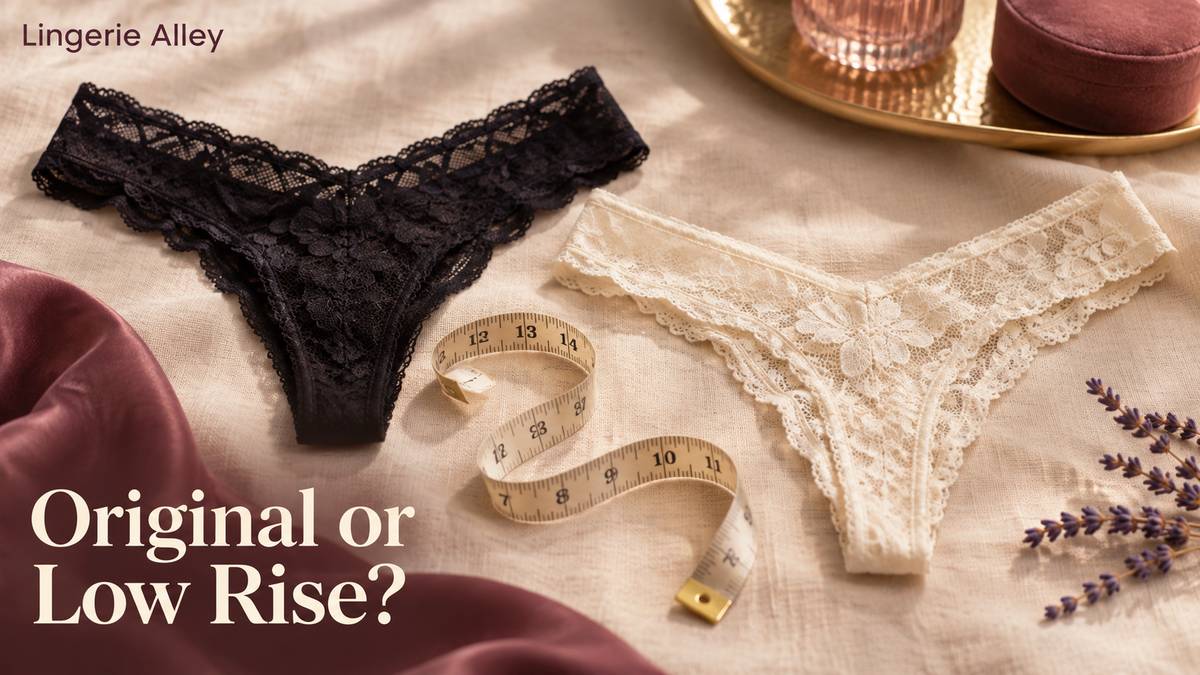
Lay a Hanky Panky Original Rise thong next to a Low Rise and the difference looks almost trivial. Same scalloped stretch lace, same tiny cotton-lined gusset, same V dip at the front and back of the waistband. The Original simply has a taller triangle of lace between waistband and gusset. Put each one on, though, and they behave like two different garments, because that extra height decides where the waistband lands on your body, and where the waistband lands decides almost everything about comfort.
This is a comparison of those two cuts only, in the brand's Signature Lace version. If you want the bigger picture on thong styles, fabrics and the health questions people ask, our complete thong guide covers that ground.
What the brand says about each cut
Hanky Panky's own style guide describes the two in one line each. The Original Rise "sits high on the hips, above the hip bones." The Low Rise "fits low on the hips." Both use what the brand calls its V-front, V-back waistband, where the lace edge dips toward the center at front and back instead of running straight across.
The one-size ranges, as listed on the brand's style guide as of late 2026:
- Original Rise: sizes 4 to 14, hips about 36 to 45 inches. A plus version covers sizes 14 to 24, hips about 44 to 57 inches.
- Low Rise: sizes 2 to 12, hips about 35 to 42 inches. A petite version covers sizes 0 to 4 (hips 33 to 36 inches), and an XXS version covers sizes 000 to 00 (hips 29 to 33 inches).
Notice how much those ranges overlap. Anyone with hips between 36 and 42 inches is inside both. For most people, then, hip measurement alone will not settle it. The real question is where you want the waistband to sit and what your hips do at that height.
Where each waistband lands on your body
Original Rise: above the hip bone
On most bodies the Original's waistband settles somewhere between the top of the hip bone and the natural waist, roughly where a mid-rise pair of jeans ends. Because the lace stretches around the widest part of your pelvis and then comes back in a little, the band has something to hold onto. It sits on a slight slope rather than on the widest point.
That position has two practical effects. First, the band is less likely to roll down when you sit, since it is not perched on a ledge. Second, it shows above anything cut low. With low-rise trousers or a cropped top, a strip of lace may peek out at the back.
Low Rise: below the hip bone
The Low Rise waistband sits lower, usually across or just under the hip bones, closer to where a low-rise jean ends. There is less lace overall, so on a narrow frame it can feel barely there.
The trade-off is that the band now crosses the bony, widest part of the pelvis, or sits just under it. On some hips that is the most secure spot of all. On others, especially where the body curves in sharply below the hip bone, a band at that height can slide or roll toward the curve.
Choosing by hip shape and proportions
Hip measurement tells you circumference. It does not tell you shape, and shape is what decides whether a waistband stays put. A few patterns come up again and again in fitting rooms.
If your hip bones are prominent
When the hip bones are the first thing a waistband meets, the Low Rise band can rest right on them. Some people like this because the band has a firm anchor. Others find the elastic edge presses on the bone after a few hours of sitting. The Original avoids the issue by clearing the bones and sitting on softer tissue above.
If your waist-to-hip difference is large
With a defined waist and fuller hips, the Original tends to be more stable. Its band rides up into the inward curve toward the waist, where stretch lace naturally wants to settle. A Low Rise on the same body sits on a wider part of the hip and has room to drift upward or roll at the top edge as you move.
If your hips are straight or your frame is narrow
A straighter silhouette gives a waistband fewer slopes to settle on, so the Low Rise's smaller amount of lace is often the cleaner fit. If your hips measure near the bottom of the one-size range, the petite Low Rise exists for exactly this reason, and the XXS goes smaller still. The style guide lists no petite Original, so on a narrow frame its band may feel looser than expected.
If your hips sit near the top of the range
Above about 42 inches you have moved past the one-size Low Rise range, and the Original Rise or the Original plus version is the listed fit. Between 44 and 45 inches, both the one-size and plus Originals are listed, so it comes down to whether you like the lace snug or relaxed.
If you carry softness at the lower belly
This is about comfort, not appearance. A waistband that crosses the lower belly at its softest point can fold over when you sit. The Original usually clears that zone and sits higher. The Low Rise sits under it, which some find comfortable and others find leaves the band slipping down. Neither is wrong. Try sitting in each for ten minutes and see which one you stop noticing.
Matching the cut to what you wear over it
The cut that fits your body best still has to work with your clothes. A quick guide:
- High-waisted jeans, skirts and trousers: Either works, since both disappear under a high waistband. The Original's higher band is less likely to create a visible line across the seat because it ends above where the fabric pulls tight.
- Mid-rise jeans and work trousers: The Original is the usual match. Its band lands near the top of a mid-rise waistband and stays under it.
- Low-rise bottoms and hip-slung skirts: The Low Rise was designed for these. An Original will usually show above the back of the waistband when you bend or sit.
- Bodycon dresses and thin knits: Both thongs reduce lines at the seat. The difference is the waistband: wherever it sits, it may show as a soft ridge through very thin fabric. Pick the cut whose band sits where your dress fits loosest.
- Leggings and workout wear: Most leggings are high-rise, so the Original pairs easily. Remember that lace is a nylon fabric with a cotton gusset, not a moisture-wicking performance fabric, so for hard training you may prefer something made for it.
How to test the fit at home
You do not need a fitting room. Try each cut against these checks with the tags still on, and read the retailer's return policy first, since many treat worn underwear as final sale.
The sit test
Sit in a dining chair for a few minutes, then lean forward as if reaching for a bag on the floor. A well-fitted band stays where it started. If it rolls down at the front or slides at the back, the cut is sitting on a part of your hips that slopes the wrong way.
The two-finger test
Slide two fingers under the waistband at the side. They should go in without forcing the lace, and the band should spring back flat when you remove them. If it stays rippled or lifts off the skin, the one-size is too big for you; that is when the petite Low Rise is worth trying. If the lace leaves a deep red line after an hour, you may be at the top of the one-size range, and the plus Original is the next step up.
The V check
Look at the back in a mirror. The V of the waistband should point straight down at the center, not twist to one side. A twisted V usually means the lace is being pulled unevenly across the hips, which happens when the band sits on a sharp curve. Switching cuts often fixes it.
The gusset check
The narrow back strap should lie flat without tension, and the cotton gusset should sit fully under you rather than pulling forward. If the back feels tight when you stand straight, the rise is too short for your torso, and the Original's extra height helps.
Frequently Asked Questions
Can I wear the same size in both cuts?
Usually, yes, since both come in a one-size version that covers most of the same hip range. The difference is where the band sits, not how much it stretches. If your hips are under 36 inches, though, the one-size Original may feel loose, and the petite Low Rise is the closer fit.
Does the Low Rise give less coverage at the back?
Both are thongs, so back coverage is a narrow strap in either cut. The Low Rise has less lace at the front and sides because the waistband is lower. At the back the visible difference is mostly the height of the V.
Is the Original Rise better for tall women or a long torso?
Often, because the extra lace height leaves more room between waistband and gusset, which matters if the back strap feels tight on a longer torso. Hip shape still counts, so run the sit test before you commit to a multi-pack.
Which cut makes a better gift if I do not know her size?
The one-size Original covers the widest single range, so it is the safer guess when you know only a dress size between 4 and 14. If she wears mostly low-rise jeans, choose the Low Rise. More small gift ideas are in our stocking stuffers under $50 roundup.
One more thing before you order
If you are torn, buy one of each in the same color rather than a pack of either. Wear them on two ordinary days, not a special occasion, since a thong you notice at your desk at 3 p.m. is the real verdict. Once you know which rise disappears on you, the brand's other fabrics are easier to choose, since several of its thong lines are sold in Original and Low Rise versions too. To compare Hanky Panky with other labels that make soft lace underwear, browse our brand directory.
Find Your Perfect Fit
Take our 60-second quiz and get personalized lingerie recommendations matched to your body, style, and budget.
Take the Quiz