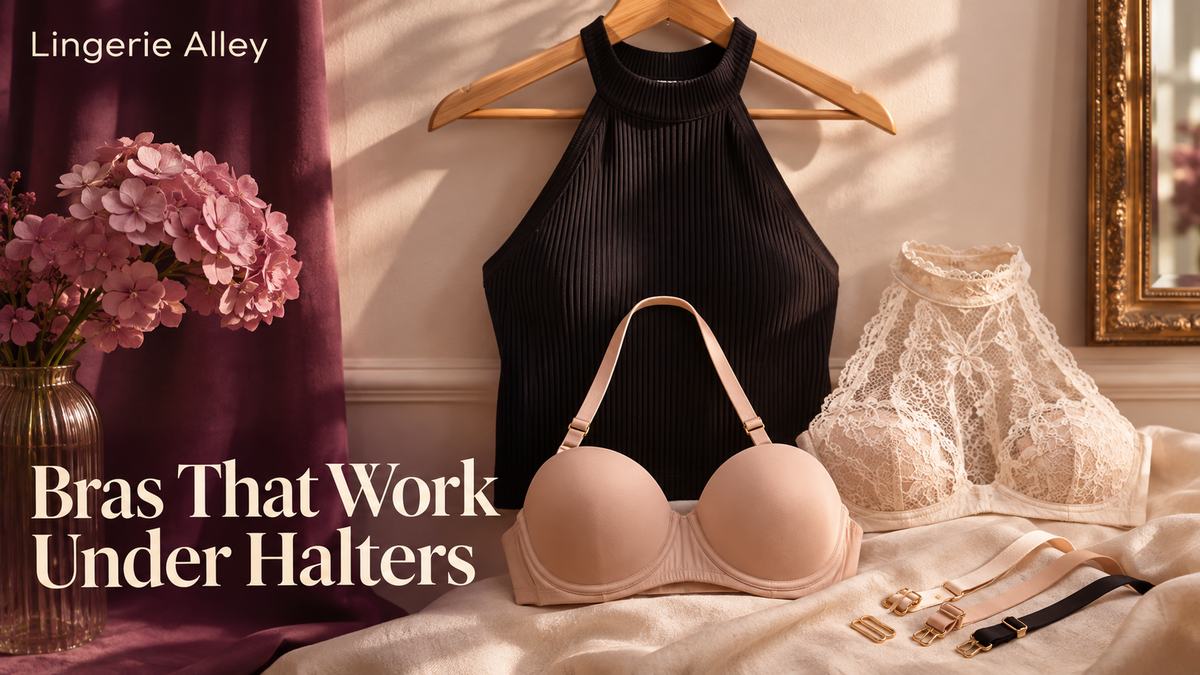
Put on a halter top over your usual bra and look in the mirror from three angles. From the front, the straps are probably fine, hidden under the fabric that runs up to your neck. From the side, you will likely see the outer edge of the cup and the strap sitting in the open armhole. From the back, the band runs straight across bare skin. A halter covers the one place a regular bra strap usually lives and opens up the two places it does not expect to be seen.
So "wear a strapless" is sometimes right and sometimes not. It depends on how your halter is cut, and that takes a minute to read.
Read the Halter Before You Pick the Bra
Halter is a family of necklines, not one shape. The ones you will meet most often:
- Classic halter. Two panels run from the bust up to a tie or clasp at the back of the neck. Armholes are cut in toward the neck, so shoulders and the sides of the upper chest are bare. The back varies more than the front: some are fully lined, some have a strip across the band line, and some are open to the waist.
- High-neck halter. A mock neck or crew collar with cutaway shoulders. The front covers the whole chest, the armholes are cut in at an angle, and the back is often a covered panel or a keyhole.
- Plunging halter. Two narrow straps that form a deep V down toward the sternum before meeting at the waist or under the bust. Common in evening dresses and swimwear-inspired tops.
Now put the top on with no bra and check three things in the mirror:
- Armhole depth. Where does the fabric edge sit relative to your underarm? If it is an inch or more inward from where your bra's side wing would sit, a standard band will show at the side.
- Back height. Is the back covered at bra-band level, or bare? A bare back at band level removes most of your options unless you are happy for the band to show.
- Neckline width. How far apart are the two halter panels at the base of your neck? This tells you whether a halter strap on the bra can hide under them.
With those three answers, you can skip straight to the section that fits.
The Convertible Bra With a Halter Strap
For a classic halter with a covered or partly covered back, a convertible bra set up in halter mode is usually the first thing to try. Convertible bras have detachable straps with small hooks at each end that clip onto loops at the front top of each cup and at the back band. To make a halter, you unhook the straps from the back and clip both front ends to a single strap that goes around your neck, or link the two straps together behind your neck.
What makes one work
- Strap loops set close to the center of the cup. The halter panels on your top angle in toward your neck. If the bra's strap attachment sits at the outer top edge of the cup, as it does on many balconettes, the halter strap will angle out past the edge of your top. Loops set closer to the gore follow the line of the neckline.
- A narrow, low-cut cup shape. Plunge and demi cups have less fabric at the outer top edge, so less of the cup shows in a cutaway armhole.
- A band that does the work. In halter mode, the strap pulls the cups up toward the neck. If the band is loose, the neck strap ends up holding the weight of the bust, and you feel it as tension at the back of the neck within an hour. Fit the band so it stays level on its own, then treat the halter strap as a guide, not the support.
The two-minute fitting test
Put the bra on in halter mode and tighten the neck strap until the cups sit where they normally do, and no tighter. Then lean forward, raise both arms overhead, and turn side to side. If the cups lift away from your chest when you raise your arms, the strap is too tight and is pulling the cups up instead of the band holding them in place. If you feel a pressure point on the bone at the base of your neck, loosen it a notch and check the band again. A halter strap you can slide two fingers under is about right for most people.
Where it falls short
Convertible cups have to work in several strap positions, so they are a compromise. If you wear a fuller cup size, the halter position can concentrate pressure on the neck even with a good band, and a longer wear (a wedding, a full workday) may be more comfortable in another option.
High-Neck Bralettes and Halter Bralettes
A high-neck halter top, or any halter that will show a little edge no matter what, is a good candidate for a bra that is meant to be seen. High-neck bralettes have a band of fabric that rises above the bust, often in lace or a ribbed knit, and some have their own halter neck built in.
The idea is to match rather than hide. A black lace high-neck bralette under a black halter top shows a sliver of lace at the armhole, and it reads as a layer rather than a slip. This works best when:
- The top is a similar color or a deliberate contrast, not a near match that looks like a mistake.
- The bralette's own armhole is cut at roughly the same angle as the top's, so the edges line up instead of crossing.
- You are comfortable with soft support. Many bralettes are unlined and wireless, which is fine for some bodies and not enough for others.
If you need more structure, look for bralettes sold in band and cup sizes rather than S, M, L, which tend to have wider bands and better-shaped cups. You can browse brands by category in our brand directory to find makers that size bralettes this way.
When Strapless Is Still the Best Answer
Some halters leave nothing to hide a strap behind. A plunging halter, or a classic halter with a bare back and deep armholes, will show any strap and usually any band. In those cases a well-fitted strapless bra is often the most practical answer, for a simple reason: it gets out of the way of all three zones at once.
The usual strapless rules apply here. Go by the band, which carries all the support. Look for silicone grip along the top and bottom edges of the band, side boning, and a band at least an inch or so deep. We cover how to choose one that stays put in detail in strapless bras that actually stay up.
Two halter-specific checks:
- Side wing height. In a halter with deep armholes, the side of a strapless bra can still show. Hold your arm at your side and look in the mirror. If the wing shows, a style with a lower or angled side wing, or a longline strapless that drops lower and sits under the armhole, may help.
- Center front depth. For a plunging halter, a strapless with a low center gore matters as much as the strap question. A standard strapless with a high center will show in the V.
If your back is bare to the waist, no band will hide. Your options narrow to self-adhesive cups, nipple covers, or adding cups to the garment itself.
Building Support Into the Top
Halters in heavier fabric can sometimes carry their own support.
Sew-in bra cups
Foam cups made to be stitched or pinned into a top's lining give shape and opacity rather than real lift, which is plenty for some people and too little for others. Tack them to the lining at three or four points rather than sewing all the way around, so the outer fabric does not pucker, and position them with the top on, since the halter panels pull the fabric upward once they are tied.
A tailor's built-in bra
For a dress you will wear more than once, a tailor can add cups attached to an internal band that closes under the dress fabric. In a deep halter with a bare back, it is the one option that gives full support with nothing visible.
Frequently Asked Questions
Can I just wear a regular bra with the straps crossed behind my neck?
You can try, but most standard bras do not have detachable straps, and pulling fixed straps inward strains the attachment points and often twists the cups. A bra sold as convertible, with hooks at both strap ends, is designed for this. Even then, the band should hold your bust in place, with the neck strap only guiding.
Why does a halter bra give me a sore neck?
Usually because the neck strap is carrying weight that the band should carry. Check that the band sits level and snug on the loosest hook, then loosen the halter strap until it only holds the cups in position. If the ache continues with a well-fitted band, switch to a strapless or built-in option for long wear.
What color bra is least visible under a light halter top?
A shade close to your own skin tone usually shows less than white under light fabric, because white contrasts with skin through the weave. Under a black or dark halter, black is the safest choice.
Do halter swimsuit tops work as a bra under a halter top?
Sometimes, as a casual fix. A swim top with a halter tie already has the right strap shape, but swim fabric and lining can be warm and may not give the same support as a bra. It can work for a few hours on a hot day, and less well for a long evening.
The next time you buy a halter top, try it on with the bra you plan to wear before you take the tags off, and check the side view as well as the front. If you are not sure which cup shape suits your build, our style quiz includes a breast shape step that points you toward cup styles worth trying, and the same approach carries over to off-the-shoulder necklines in our guide to what bra to wear with off-the-shoulder tops.
Find Your Perfect Fit
Take our 60-second quiz and get personalized lingerie recommendations matched to your body, style, and budget.
Take the Quiz