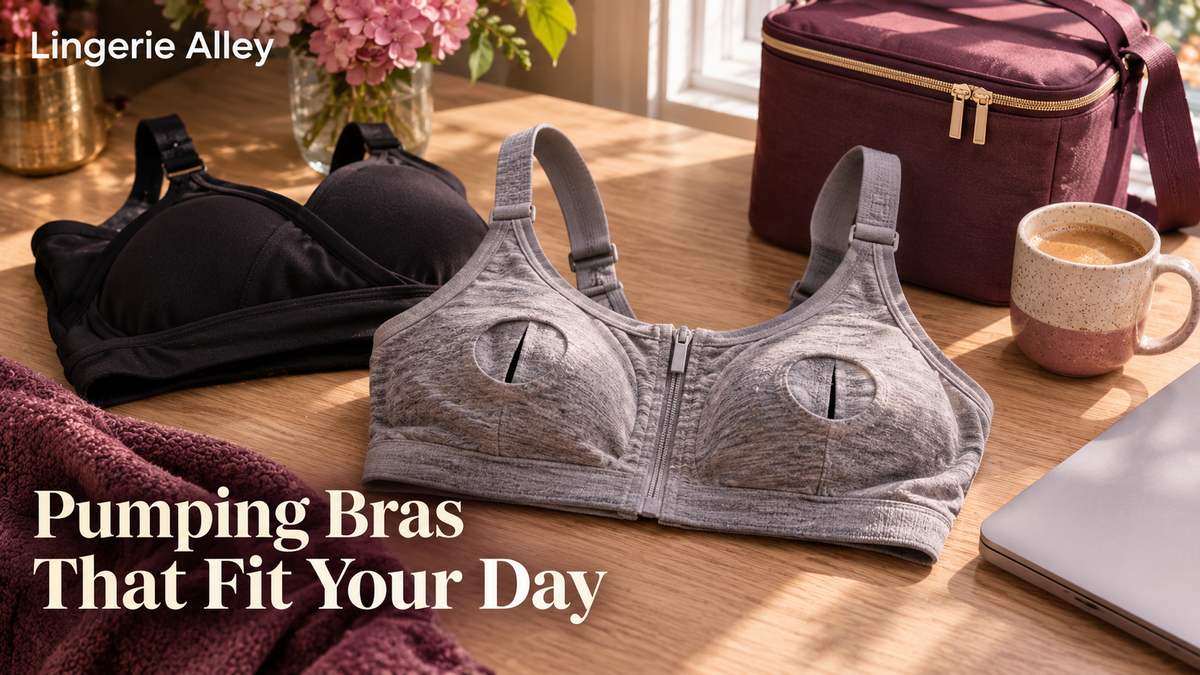
Picture the pumping room at a typical office: a chair, an outlet, a small table, a door that locks, and a schedule that gives you a short window before the next meeting. In that window you have to undo your top, get two flanges sealed, start the pump and ideally answer an email while it runs. Whether that works or turns into a juggling act depends almost entirely on what you are wearing under your shirt.
A hands-free pumping bra does one job: it holds the flanges against your breasts so your hands are free. How it does that job varies a lot, and the right choice depends less on the brand than on the shape of your day. This guide is about pumping. If you are mostly nursing at the breast and want a bra that looks less clinical, our guide to nursing bras that don't look like medical equipment covers that ground.
The three designs, and how each one holds a flange
Every hands-free pumping bra has two openings, one over each nipple, sized so the narrow neck of the flange (the funnel-shaped breast shield) passes through and the fabric grips it. The differences are in what surrounds those openings.
Pumping-only bustiers
This is the original design: a stretchy tube or bustier, usually with a front zipper and a wide adjustable back. The Simple Wishes Signature is the familiar example, with a front zip, a hook-and-loop back panel that adjusts over several inches, and optional shoulder straps. It goes on over your bare chest or over a dropped-down nursing bra, only for the length of the session.
What it does well: grip. Because the fabric is firm and the band tightens to you, the flanges are pressed in evenly, and seals tend to hold even when you lean forward to type. The adjustable back also copes with the size swings of the first months.
What it asks of you: a full changeover. You take off or unclip your regular bra, put the bustier on, pump, then reverse it. At home that is fine. In a 20-minute work slot, the extra few minutes add up across a day. The hook-and-loop also needs to be lined up carefully, because loose hooks scratch skin and snag knits.
Clip-on panels that attach to your nursing bra
The second design is a panel with openings that clips to the hooks of a nursing bra you are already wearing. The Bravado Clip and Pump is the best-known version: you drop your nursing bra's cups, clip the panel onto the same clasps, and slide the flanges into figure-eight openings that let you insert or remove a flange without unscrewing it from the bottle.
What it does well: speed and flexibility. You never take your bra off, so the changeover is quick, and the panel folds small enough for a pump bag. The design also lets you pump one side while nursing on the other, which is useful once you are back at home.
What it asks of you: a nursing bra with compatible clips, and a panel sized for your chest. Because the hold depends partly on the nursing bra underneath, a stretched-out bra gives a looser grip. Expect to fiddle with flange position for the first few sessions.
All-day pumping and nursing bras
The third design builds the pumping openings into a bra you wear all day. Typically there is an outer nursing cup that unclips and an inner layer with small slits or a crossover panel that holds the flange. Kindred Bravely's Sublime Hands-Free Pumping and Nursing Bra works this way, and it is sold in standard and busty versions of alpha sizes, roughly XS to 3X depending on the style, so check the brand's size chart against your current measurements.
What it does well: zero changeover. You unclip, slot the flanges in, and start. For three sessions a day at work, this is often the deciding factor.
What it asks of you: a softer hold. A bra comfortable enough to wear for 14 hours is, by definition, less firm than a pumping-only bustier, so flanges can tilt when you lean or when bottles fill and gain weight. Sitting upright and fastening the band on a tighter hook usually steadies them.
Match the bra to your day
Rather than ranking products, it is more useful to ask where most of your sessions happen.
Office or shared pumping room
Changeover time matters most here, and so does discretion under work clothes. An all-day pumping and nursing bra is the low-effort choice. A clip-on panel over your usual nursing bra is close behind and lets you keep a nursing bra you already like. Wear a top that opens at the front or lifts easily: a button-front shirt, a wrap top, or a two-layer setup with a camisole under a cardigan.
Exclusive pumping at home
If you are pumping eight or more times a day, sometimes at 3 a.m., grip and seal reliability matter more than speed. A pumping-only bustier is worth having, possibly alongside a softer bra for the hours in between. Some people keep the bustier on the pump cart so it is always within reach.
In the car, on a plane or between appointments
Pumping in a parked car or a cramped bathroom stall means awkward angles and no table. A firm hold helps, because you may be twisted or holding a phone. A clip-on panel packs smallest. A pumping-only bustier holds best. Whatever you choose, practice the full changeover at home before you need it somewhere tight.
Wearable in-bra pumps
Cup-style wearable pumps sit inside your bra rather than through a slot, so a slotted pumping bra is not the right tool. What they need is a snug, non-padded nursing bra or sports bra with enough cup room to hold the pump flat against the breast. Follow your pump maker's own bra guidance, since cup shapes differ between models.
Fit details that decide whether it works
Pumping bras are often sold in alpha sizes, which means the fit test matters more than the label.
- Band first. The band should sit level and feel snug on the loosest hook, so you can tighten it as it stretches. A loose band lets the whole front drop as bottles fill.
- Opening height. The slot or slit should land right over the nipple when you stand and when you sit. Sit down in the fitting, because breasts shift when you sit and lean forward.
- Opening size. Flange necks vary between pump brands and sizes. The fabric should grip the neck firmly but not stretch tight around it. If the opening is far looser than the neck, the flange will rotate.
- No pressure ridges. Seams, wires and tight edges should not press into breast tissue. The NHS advises against tight-fitting clothing or bras while recovering from mastitis, so firm is fine, but a line that digs in is not.
- Fabric and wash. Expect milk on it. A cotton or modal blend with spandex washes easily. Check whether the openings are reinforced, because unbound slits tend to stretch and fray after many washes.
Flange size is a separate question from the bra. A flange that is too small or too large can hurt and affect output, and an IBCLC (a certified lactation consultant) can measure you. Sort that out first, because no bra fixes a poorly fitted flange.
How many to buy, and when
If you are going back to work, buy one pumping solution two or three weeks before your return date and do a full dress rehearsal: work outfit, pump bag, timed changeover. That shows whether your top works with the bra before you are standing in the pumping room. During the rehearsal, put your hands in your lap once the pump is running and check whether you can type, sip coffee and stand up without either seal breaking. If one side drops, adjust the band or the opening height now, while you still have time to swap the bra.
For an all-day pumping and nursing bra, two or three is a practical number, one to wear, one in the wash and one spare for leaks. For a bustier or clip-on panel, one is usually enough at first, with a second for the office bag if you pump both at home and at work.
Your size will likely shift more than once in the first months, especially if your supply changes or you wean. Our post-pregnancy lingerie guide covers what tends to change and when it is worth buying again. You can also browse nursing and maternity specialists in our brand directory.
Frequently Asked Questions
Can I wear a hands-free pumping bra all day?
Only if it is designed as an all-day pumping and nursing bra. Pumping-only bustiers are built to grip firmly for the length of a session and are not meant for hours of wear. If you want one garment from morning to night, look for a nursing bra with built-in pumping slits.
Does a pumping bra work with every breast pump?
Most slotted pumping bras work with standard flanges from the major electric pumps, because they grip the narrow neck of the flange. Flange necks vary in diameter, so check the fit with your own pump. Cup-style wearable pumps are different and usually need a snug regular bra rather than a slotted one.
Why do my flanges keep slipping in my pumping bra?
The usual causes are a band that is too loose, openings that sit too high or too low when you are seated, or an opening that has stretched with washing. Try the tightest hook, sit upright, and check whether the flange neck turns easily in the slot. If the bra is old, the elastic may simply be worn out.
Can I make a hands-free pumping bra from a sports bra?
People do cut small slits in an old sports bra as a stopgap, and it can work for a while. Without reinforced edges, though, the slits stretch and run quickly, and the hold weakens. It is fine as a backup, but a purpose-made bra will hold the flanges more steadily.
Find Your Perfect Fit
Take our 60-second quiz and get personalized lingerie recommendations matched to your body, style, and budget.
Take the Quiz